
I worked hard to bring you a subject that is on everybody’s lips at family gatherings. Here is some real material to keep for the next family party, the one with the brother-in-law.
These six pieces have one job: to take apart the myths and half-truths that sit stubbornly in how people think about this. Not by shouting louder than the next guy. By measuring them one at a time, with sources you can go and check yourself.
Six pieces on batteries, from the day one leaves the factory to the day it is taken apart.
- Today, the price. What it used to cost, what it costs now, and why the figures people throw at you do not hold up.
- Saturday, how long it lasts in the car. A pack that falls from 400 km of range to 140 is not a dead pack. It just changed jobs.
- Next Wednesday, repair. Why a section gets replaced instead of the whole pack, and what that does to the math.
- Saturday, October 3, the second life. A house, a cottage, a wind turbine, solar panels.
- Wednesday, October 7, recycling, and the real reason you do not see much of it yet.
- Saturday, October 10, the piece nobody puts in the debate. While the battery keeps improving, oil keeps getting worse.
With that, let’s get into it.
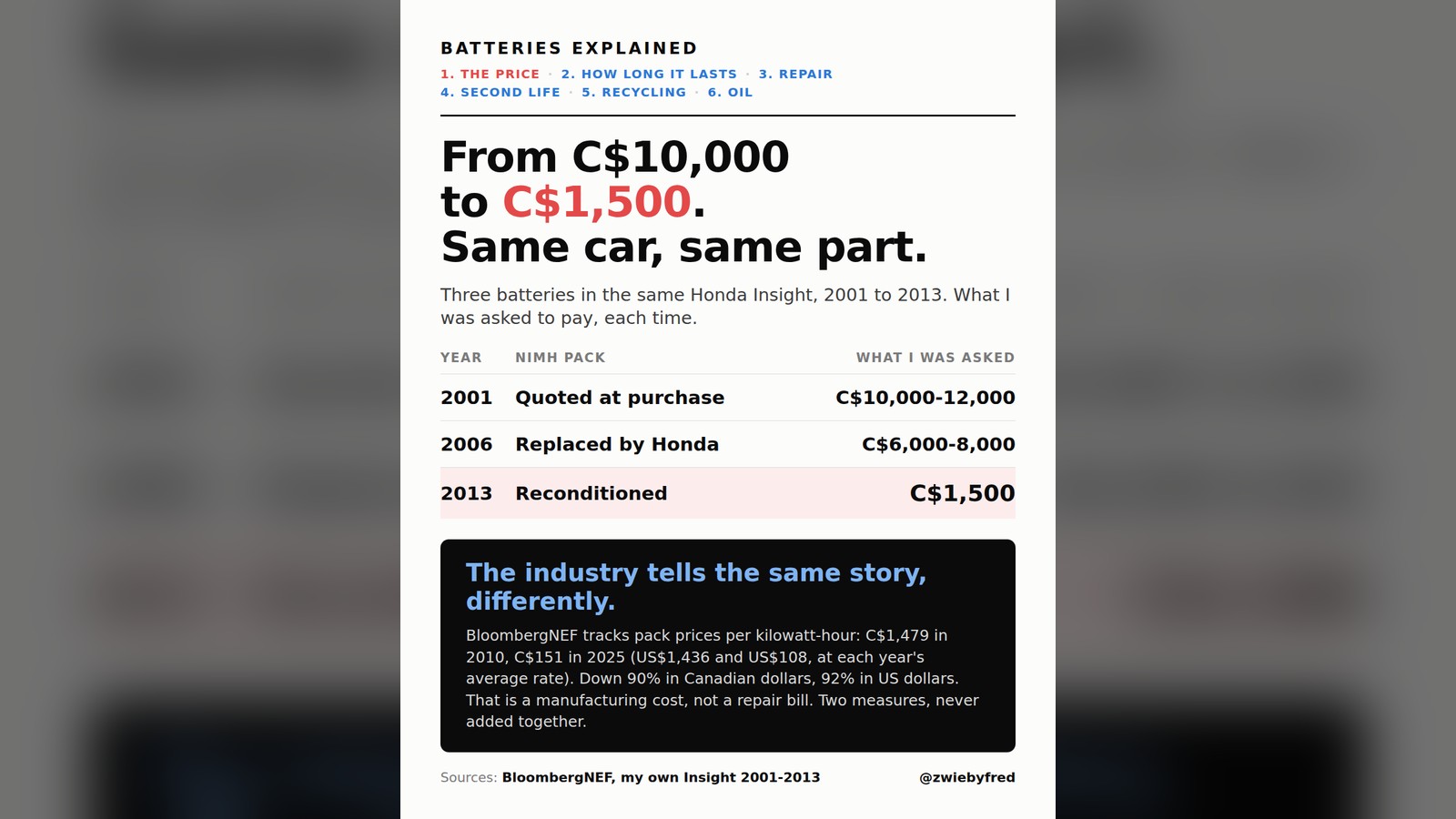
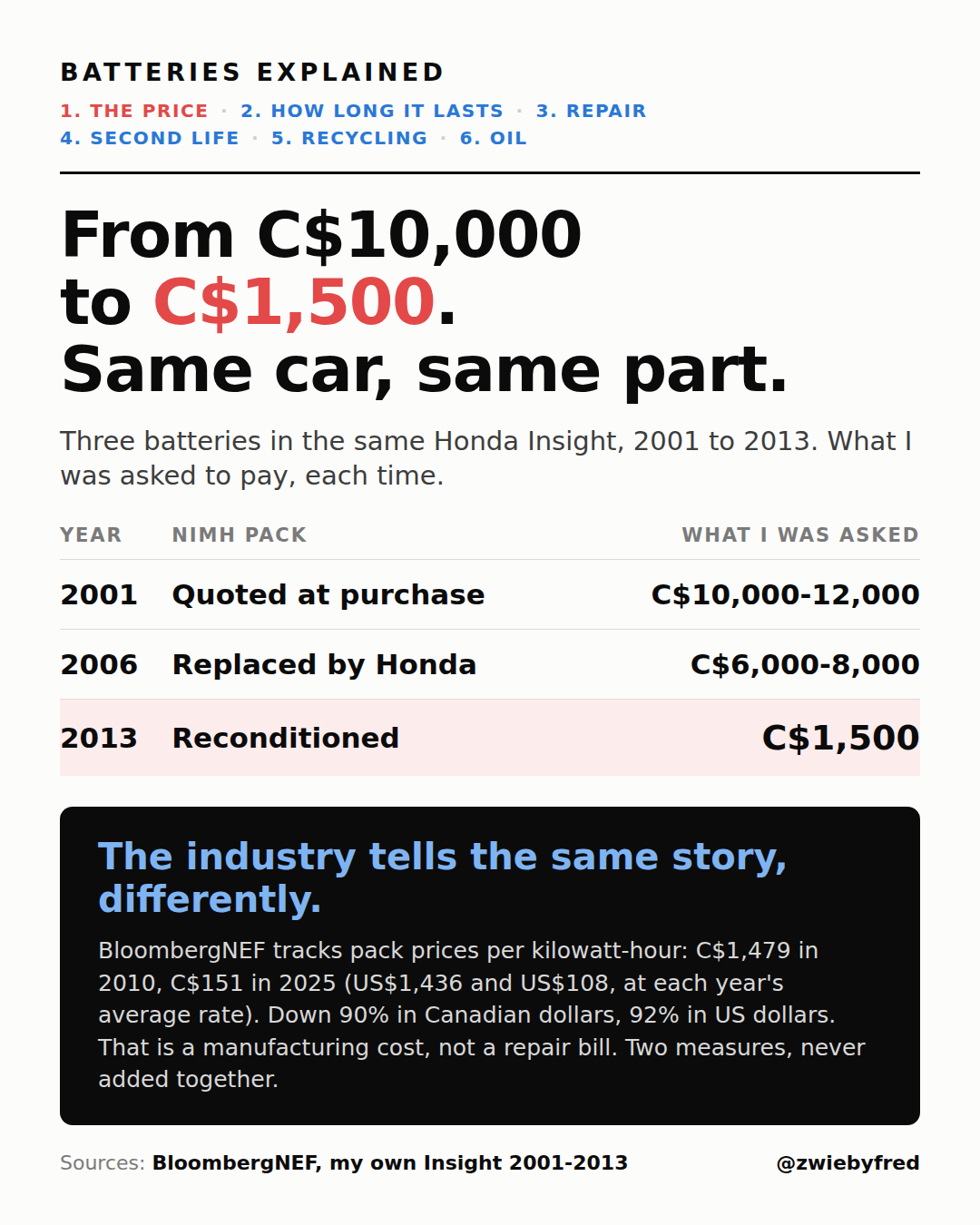
I paid for three batteries on the same vehicle between 2001 and 2013. It is the best price curve I can show you, because it is mine.
In 2001 I bought a used Honda Insight, my first hybrid. The nickel-metal hydride pack in it was quoted to me at somewhere between C$10,000 and C$12,000 if I ever had to replace it.
In 2006 it failed. Honda replaced it. Between C$6,000 and C$8,000.
In 2013 it failed again, at 350,000 km. That time I put in a reconditioned unit. C$1,500.
Twelve years, same car, same part. From C$10,000 down to C$1,500.
Those are the amounts I was asked to pay, not market prices I looked up. This is my own experience, from memory. And it was nickel-metal hydride, not lithium. Different chemistry, different era. I say it before anyone else does.
Now the other measure, the industry one. BloombergNEF runs an annual survey of battery pack prices per kilowatt-hour. That is a manufacturing cost, not a repair bill, so do not mix the two. Everything below is in Canadian dollars, each figure converted at its own year’s average Bank of Canada rate, with the original amount in brackets.
In 2010 the average pack cost C$1,479 per kilowatt-hour (US$1,436). In 2024, C$158 (US$115). In the survey published last December, for 2025: C$151 (US$108). Down 90% in Canadian dollars. BloombergNEF measures the drop in US dollars and gets 92%: the gap is our own dollar, which slid over the same period.
Three details from that last survey are worth your time. Packs destined for electric vehicles sit at C$138 per kilowatt-hour (US$99). Split by chemistry, lithium iron phosphate is at C$113 (US$81) and nickel manganese cobalt at C$179 (US$128). Split by region, China is at C$117 (US$84), while North America pays 44% more than China and Europe 56% more.
That regional premium is worth naming for what it is. It comes from industrial and trade policy choices that can be defended on their own terms, but it has a price, and that price shows up on the sticker in front of a North American buyer.
And the price of replacing a battery today? I thought there was no serious source for it. I was wrong, and I found one. Recurrent published a list in December 2024 of prices quoted by American dealers and independent shops. A 24 kWh Leaf, C$5,500 to C$8,900 (US$4,000 to US$6,500). A 2018 Bolt, C$22,300 (US$16,250). A 2023 Model 3 Long Range, about C$17,800 (US$13,000). A Mustang Mach-E, over C$46,600 (US$34,000). A BMW i3 at a dealer, over C$45,200 (US$33,000), with some cases as high as C$97,300 (US$71,000).
So the person throwing $30,000 at you is not making it up. They are taking the worst case and presenting it as the average. And they leave out the one thing that actually matters: the U.S. Department of Energy counted replacements due to failure across about 15,000 vehicles. One and a half percent across all model years since 2011, and well under one percent for model years 2016 and newer. Excluding recalls, which I should say plainly, because the Bolt and Kona recalls are not in that number.
A price that almost never applies is a scarecrow, not an argument.
What I paid, on the other hand, I remember. Same vehicle, twelve years, price divided by seven.
On Saturday, part two: how long a battery lasts in the car. A pack that drops from 400 km of range to 140 is not a finished pack. It is a pack that just changed jobs.
What do you tell the people who say a battery costs as much as a car to replace?
Sources: BloombergNEF annual battery pack price survey, editions of December 10, 2024 and December 9, 2025 · Recurrent, EV battery replacement cost survey, December 3, 2024 · U.S. Department of Energy, April 22, 2024, battery replacement rates due to failure · International Energy Agency, Global EV Outlook 2026 · Bank of Canada annual average exchange rates