
Part 5 of 6 on batteries. Saturday was second life. Today, recycling. And I told you: I had a good news story prepared.
The plan was simple. Tell you about Lithion, the Quebec company that was going to recover 95% of the materials in a battery, in Saint-Bruno-de-Montarville, with General Motors as a partner and Investissement Québec, the provincial investment arm, in the capital. Quebec’s link in the battery chain.
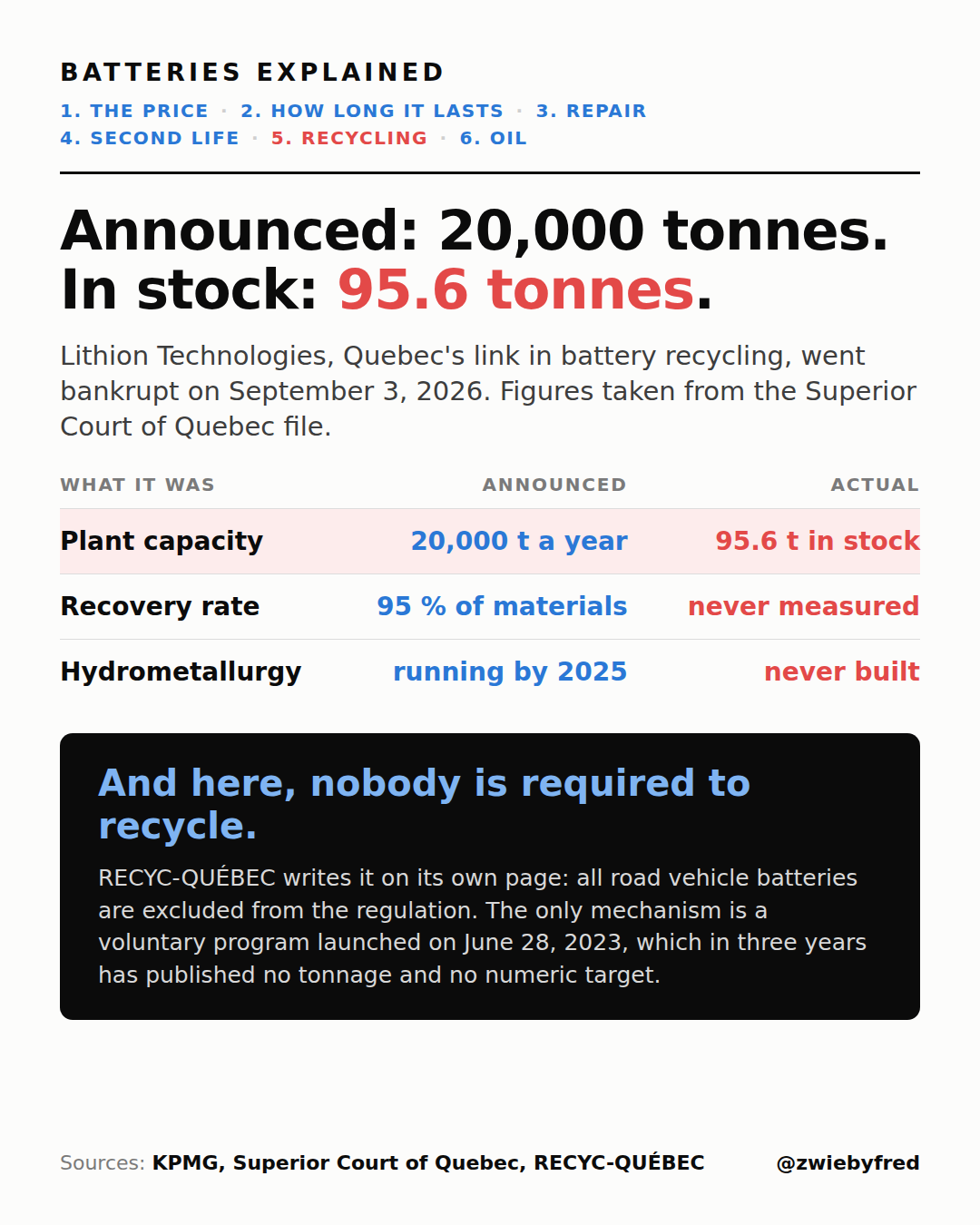
Lithion Technologies went bankrupt on September 3. KPMG was appointed trustee. The company had been under creditor protection since October 28, 2025.
I did not read this in the papers. I went into the Superior Court file, and that is where it gets instructive.
The monitor’s pre-filing report of October 27, 2025 says this: “Over $100 million has been invested in the Debtors’ business.” More than a hundred million dollars. Investissement Québec appears among the secured creditors for C$4,459,925 and General Motors Ventures for C$2,137,963. Total debt as at August 31, 2025: C$12,515,071.
Then the inventory. Six containers, 95.6 metric tons of black mass ready for sale, projected value about C$340,000. The plant had started producing in June 2024 and was to go into care and maintenance on November 15, 2025. Forty-five employees were left, after sixteen layoffs in April 2025.
A plant announced at 20,000 tonnes a year had 95.6 tonnes in stock.
Now the famous 95%. I have repeated it myself, so I am correcting myself at the same time as you.
Lithion’s process had two stages. One, shredding, which produces black mass, a concentrate. Two, hydrometallurgy, which turns that concentrate into battery-grade metals. The 95% applied to the complete process.
The second stage was never built. In June 2024 the company itself wrote that the site was still “in site selection process.” They had not even picked the land. So the 95% was never measured: it was an engineering projection, start to finish.
What actually gets recovered is measured elsewhere. A team at the National Research Council of Canada published a 2023 study of hydrometallurgical recycling with a Quebec case: nickel 92.4%, cobalt 92.3%, lithium 89.3%. And manganese 30.1%. Manganese is the M in NMC, and nobody ever mentions it.
The same study gives a figure I find even more honest: reagents account for 51% of the emissions of the recycling process, sodium carbonate alone for 38.5%. Put another way, even running on hydroelectricity, recycling still hangs on a heavy chemical industry.
Now Europe, because that is where you find the plainest admission. On September 11 the European Commission published its assessment of the recycling targets. It writes that graphite and solvents are counted in what enters the plant but are “in practise not yet recycled at a sufficiently high rate,” and that at the end of 2025 “very few recyclers were able to recover lithium from batteries.”
Its solution: a delegated regulation lets recyclers take graphite, solvents and oxygen out of the calculation until December 31, 2029. Europe hits its 65% target by removing graphite from the equation. Graphite is about a third of the mass of the cells.
In Canada there is nothing at all. RECYC-QUÉBEC writes it on its own page: all road vehicle batteries are excluded from the regulation. No law here obliges anyone to recycle an EV battery. There is a voluntary program, launched by the industry on June 28, 2023. Three years later it has published no tonnage, no battery count and no numeric target.
And Lithion is not an isolated case. Li-Cycle went to Glencore in August 2025. Ascend Elements was liquidated this year. Redwood Materials laid off 10% of its staff in April and pivoted toward energy storage. Lithion went bankrupt in September. Four in eighteen months.
The International Energy Agency gave the reason in May: recycling capacity is largely in excess compared to available feedstock globally, and recycling will remain dominated by production scrap until end-of-life batteries take the lead in the mid-2030s.
That is the real problem. It is not that recycling does not work. It is that the factories were built fifteen years ahead of the customers. The batteries they are waiting for are still out on the highway.
I will end on the part that gives hope, because there is some. The lead-acid battery, the one that starts your engine, is recycled at 97.7% in the United States over 2020-2024. The figure comes from the manufacturers’ association, so take it for what it is. But the order of magnitude is real, and it took a century: one stable chemistry, a metal worth money, a mandatory deposit and a collection network built over decades.
Lithium-ion has none of the four. Not yet.
Saturday, the sixth and final part: oil.
What do you think? Should recycling be made mandatory by regulation, the way Europe did, or should the market sort itself out?
Sources: KPMG Inc., trustee, Lithion Technologies file, Superior Court of Quebec · monitor’s pre-filing report, October 27, 2025 · Lithion Technologies release, June 3, 2024 · Gonzales-Calienes, Kannangara and Bensebaa, National Research Council of Canada, Batteries 9(7):375, 2023 · European Commission report to the Parliament and the Council, September 11, 2026 · delegated regulation (EU) 2025/606 · RECYC-QUÉBEC, batteries page · Call2Recycle Canada, June 28, 2023 · International Energy Agency, Global EV Outlook 2026 · Battery Council International, August 6, 2026