
Part 6 of 6 on batteries, the last one. Let’s close the loop.
Five parts to say what, in the end? That the price of a pack fell 90% in fifteen years. That a battery does not die, it changes jobs. That it can be repaired at the module, even if that is not yet the norm. That the second life exists but stays small. And that the recycling industry built its factories fifteen years ahead of its customers.
One difference remains, just one, and it is the one that counts. Transport & Environment put it in a single sentence in its March 2021 report: the fuel is burnt once, whereas the battery materials can be reused and recovered in a circular loop.
Now the numbers from that report, and I will start by correcting the mistake you see everywhere.
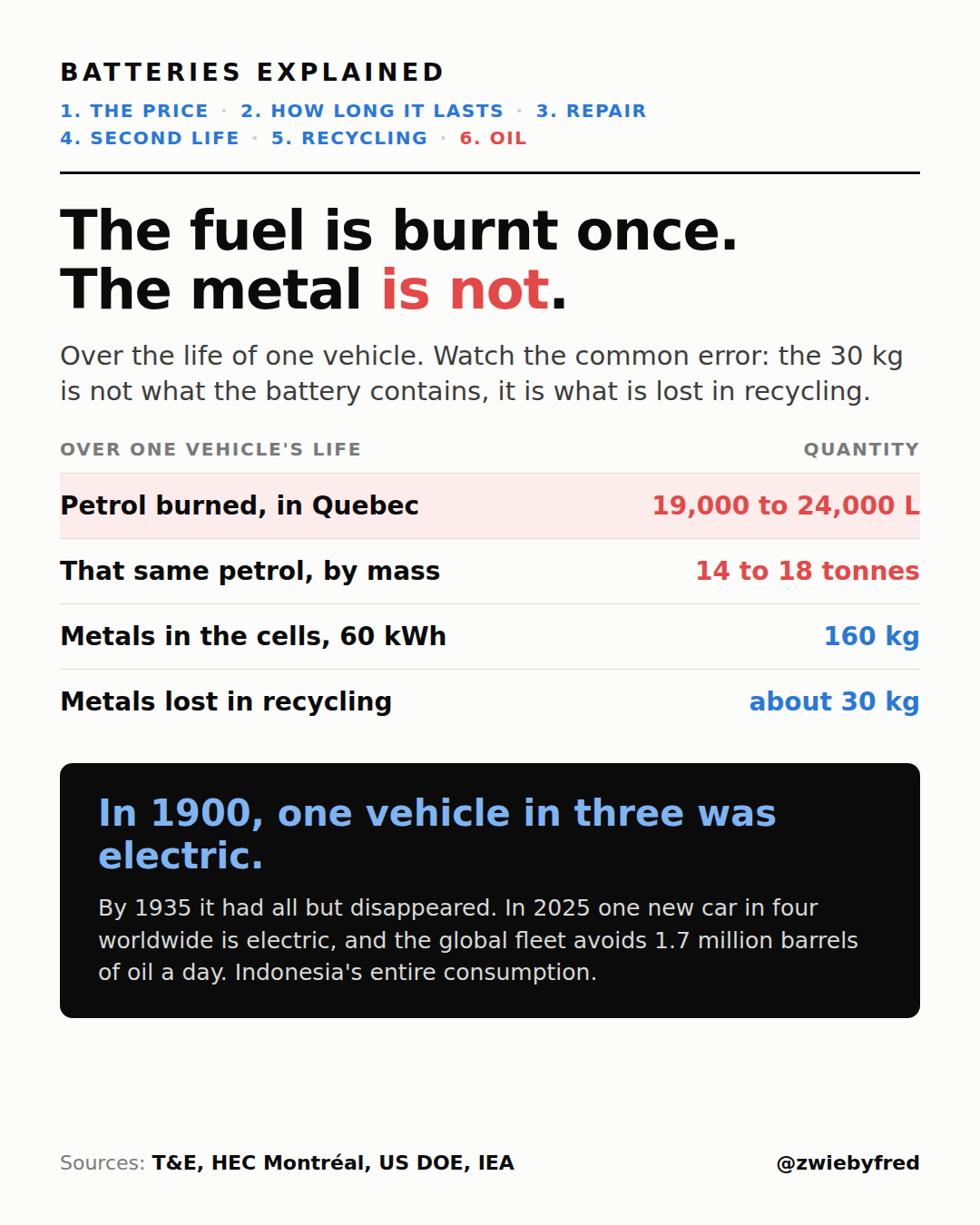
You have surely read somewhere that a battery “uses 30 kg of materials against 17,000 litres of petrol.” That is backwards. What the report says is that the metals in the cells of a 60 kWh battery weigh about 160 kg. The 30 kg is not what it contains: it is what is lost, what does not come back from recycling. That is not a detail, that is the meaning of the sentence.
So the report compares 17,000 litres of petrol burned over the life of a car, roughly 12.7 tonnes, against 30 kg of metals lost. Three to four hundred times more material on one side than the other.
Two caveats, and I am raising them myself because nobody else does.
First: the 30 kg is a scenario, not a measurement. The report applies the recovery rates the European Commission was proposing for 2030. And when you look at the breakdown (15.5 kg of graphite, 10.4 kg of aluminium, 2.9 kg of manganese) you find that 86% of the loss sits in three materials that, under the European regulation actually adopted since, carry no mandatory recovery target at all. None. Graphite is even removed from the calculation until 2029, as I described on Wednesday.
Second: the report is five and a half years old and its battery composition dates from 2020, before the rise of LFP, which contains neither cobalt nor nickel. It has never been updated.
And 17,000 litres is too low for where I live. I redid the math with local numbers. In 2024, Quebec sold 8.85 billion litres of automotive gasoline for a fleet of 5,635,194 passenger vehicles. That works out to about 1,570 litres per vehicle per year, and it is a conservative figure because electric vehicles sit in the denominator. Over twelve years, close to 19,000 litres. Over fifteen, close to 24,000.
While we are on numbers that look alike, here are two that must never be mixed up. The 17,000 litres is fuel burned over a lifetime. The 17,000 kilometres is the point at which an electric car has paid back the extra emissions from building it, according to the ICCT last July: 63 g of CO2e per kilometre over the life cycle against 235 for a gasoline car in Europe, 73% lower, with about 40% higher production emissions. Two famous figures, the same number, no relationship whatsoever. I have seen them confused inside a single article.
Now the arc of the century, because this is where I was going.
In 1900, about one vehicle in three on the road was electric. That is the U.S. Department of Energy writing it. New York City had a fleet of more than 60 electric taxis. Then 1912 arrives: Charles Kettering invents the electric starter, the hand crank disappears, and the Model T makes gasoline affordable. That year a gasoline car cost $650 and an electric roadster $1,750. The Bank of Canada does not publish exchange rates that far back, so I will give you the ratio rather than a conversion: the electric cost 2.7 times the price of the gasoline car.
Texas oil arrives, gasoline gets cheap everywhere, roads connect the cities, and the countryside does not have electricity yet. By 1935 the electric car had all but disappeared.
A hundred years later. In 2025 more than 20 million electric cars were sold worldwide, one new car in four. The global fleet avoided the consumption of about 1.7 million barrels of oil a day. That is Indonesia’s entire oil consumption.
For scale: the world used 104.3 million barrels a day in 2025, and road transport is close to half of oil demand.
Honesty is required here, because 2026 is a strange year. World oil demand is falling this year, and it is not thanks to us. The International Energy Agency, in its September 11 report, attributes the drop to the conflict in the Middle East: exports from Gulf countries ran around 13 million barrels a day in August, roughly half their pre-war level. A war is not a transition. Do not confuse the two, even when it suits our argument.
One last number, and this one I calculated myself from two primary sources. At 104.3 million barrels a day, the world extracted about 5.2 billion tonnes of oil in 2025. World production of lithium, cobalt, nickel and natural graphite that same year, according to the U.S. Geological Survey, totals 6.3 million tonnes. A ratio of roughly 800 to 1. And most of that nickel goes into stainless steel, not batteries, which makes the gap wider still.
None of which means mining is clean. It is not. But two circulating figures deserve to be set straight. The famous “40,000 children in cobalt mines” comes from a 2014 UNICEF count reported by Amnesty in 2016, and it says 40,000 children in mines across southern Democratic Republic of Congo, many of them mining cobalt. That is not the same sentence. As for lithium and water, the figures that circulate depend entirely on a contested accounting choice: whether to count brine, which is ten times saltier than seawater and unusable for anything, as fresh water.
There it is. Six pieces, one idea underneath. A battery is material you borrow. A tank of gas is material you destroy.
Thanks for following all six. What do you think? Which of the six surprised you most?
Sources: Transport & Environment, From dirty oil to clean batteries, March 2021 · ICCT, Life-cycle greenhouse gas emissions from passenger cars in the European Union, July 2025 · U.S. Department of Energy, The History of the Electric Car · International Energy Agency, Global EV Outlook 2026 and Oil Market Report of September 11, 2026 · U.S. Energy Information Administration, Short-Term Energy Outlook of September 9, 2026 · U.S. Geological Survey, Mineral Commodity Summaries 2026 · Chair in Energy Sector Management, HEC Montréal, State of Energy in Quebec 2026 · Amnesty International and Afrewatch, January 2016 · Water, MDPI, 17(11):1670