
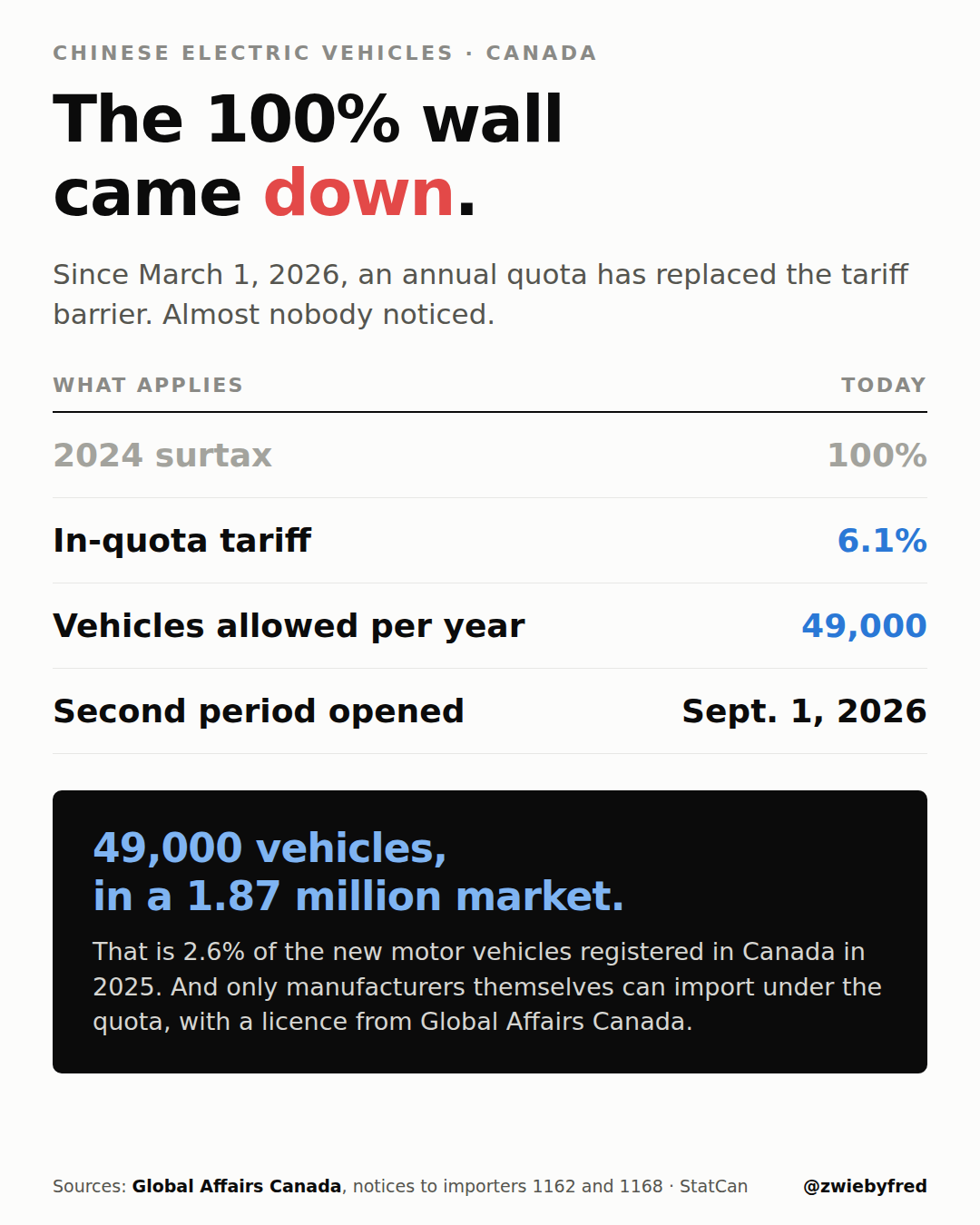
Canada’s 100% surtax on Chinese electric vehicles no longer exists. It was repealed on March 1, 2026, and outside a few articles in January and late this summer, it went by almost unnoticed.
I went and read the actual notices to importers from Global Affairs Canada, because that is where this lives, not in the headlines.
Notice 1162 states that the 100% surtax on EV imports from China, the China Surtax Order of 2024, has been repealed. In its place there is a quota: 49,000 electric vehicles a year at a most-favoured-nation tariff rate of 6.1%. It runs in two periods of 24,500, the first from March 1 to August 31, 2026, the second from September 1, 2026 to February 28, 2027, carrying over whatever the first period did not use. Notice 1168, dated August 29, confirms it.
Global Affairs has now published the first-period results. Of the 24,500 slots, 15,603 were used, or 64%. The 8,897 unused slots were carried over, bringing the second period to 33,397 vehicles. In September, 328 of them were used. There are no official figures by brand, but according to industry media, the large majority of vehicles brought in so far are Tesla Model 3s built in Shanghai. For now, the quota mostly benefits an American brand.
Here is the part that rarely gets mentioned. This is not an open import channel. An import licence from Global Affairs Canada is required before the vehicles enter the country, and access is limited to Canadian residents that are original equipment manufacturers of electric vehicles. In other words, it is reserved for automakers. Nobody is starting a Chinese car import business out of their garage on this.
For scale, Canada registered 1,867,797 new motor vehicles in 2025. A quota of 49,000 is 2.6% of that, or roughly 3% on the car-only basis the International Energy Agency uses.
Canada did not give this away for nothing. Under the January 16 announcement, China cut its duties on Canadian canola seed to a combined rate of about 15% and exempted canola meal, lobster, peas and crab until the end of 2026. Beef, pet food and animal genetics exports resume on an accelerated schedule. On the Canadian side, tariff remissions on certain Chinese steel and aluminum products stay in place through the end of 2026, and there are no duties on Chinese solar products or semiconductors.
I am not telling you whether this is a good deal or a bad one. There are arguments on both sides and this is not an opinion piece. What I wanted was the numbers on the table, because both stories going around are wrong. The people saying nothing changed are wrong, the wall came down. The people announcing an invasion are wrong too, 49,000 licensed units reserved for manufacturers is not an invasion.
One last thing, because someone will ask. As of October 12, 2026, BYD still does not sell vehicles in Canada. I checked. The brand launched a Canadian website in September, but you still cannot order or reserve anything on it. Geely has also just announced its arrival in Canada, with first sales expected in 2027 and no models announced yet.
Where would you set that number if it were up to you?
Sources: Global Affairs Canada, notices to importers 1162 (February 25, 2026, updated March 4) and 1168 (August 29, 2026), and EV quota utilization data (updated October 9, 2026) · Global Affairs Canada announcement of January 16, 2026 · International Energy Agency, Global EV Outlook 2026 · Statistics Canada, table 20-10-0025-01