
Planning ahead
About a month ago, my wife and I were invited to her great aunt’s birthday. She just turned 95, so it was a must to be there with the kids and see her extended family at the same time.
Planning was a very important part of the trip as we didn’t how the weather would play. So I used A Better Route Panner (ABRP) to get an estimate of the time to do the round trip.
Surprisingly, the normal route would have taken us about 6 hours and 40 minutes if we were to use an ICE car, without accounting for bathroom breaks, filling up the car, etc., compared to the route with ABRP which estimated the trip at 7 hours 42 minutes (682km), with 3 Superchargers stops. That is basically an hour more, but since all the stops allow us to eat and take care of the bathroom breaks, I think we should add 30 minutes to the trip with an ICE car, which brings us to about 30 minutes difference from a planning perspective.
In real life, it took us almost 8 hours to reach our destination, so an extra 20 minutes or so, compared to the planning. This was partly because one of the first stops was a 150kw and was split with another car, therefore taking a little bit longer to get our required charge. The rest of the trip was done with 250kw chargers.
Speed, temperature, and Superchargers
Along the way, our speed was 115 km/h and the temperature was averaging at 16 degrees Celsius. We kept a good pace and the hills didn’t affect us too much the range. As most of you are well aware, electric cars, just like their counterparts, are affected by the average temperature.
It is also important to note that it was extremely easy to find the Superchargers and the car automatically rerouted us to find the next Supercharger a few times when it was too close to 10% or less.
FSD version, Tesla OS version, Navigation data, and disengagements
Since I have a 2018 model, I was able to purchase the FSD long before the hike in the price of the current FSD version. Therefore, I am able to use the FSD on the highway, and I am also a beta tester for the FSD Beta city driving.
My current Tesla OS version is 2022.20.19 (FSD Beta 10.69.2.4) and the navigation data is NA-2022.28-14046. I am happy to report that I was able to start my trip from my house, all the way to Ste-Catherine, Ontario with only 3 disengagements.
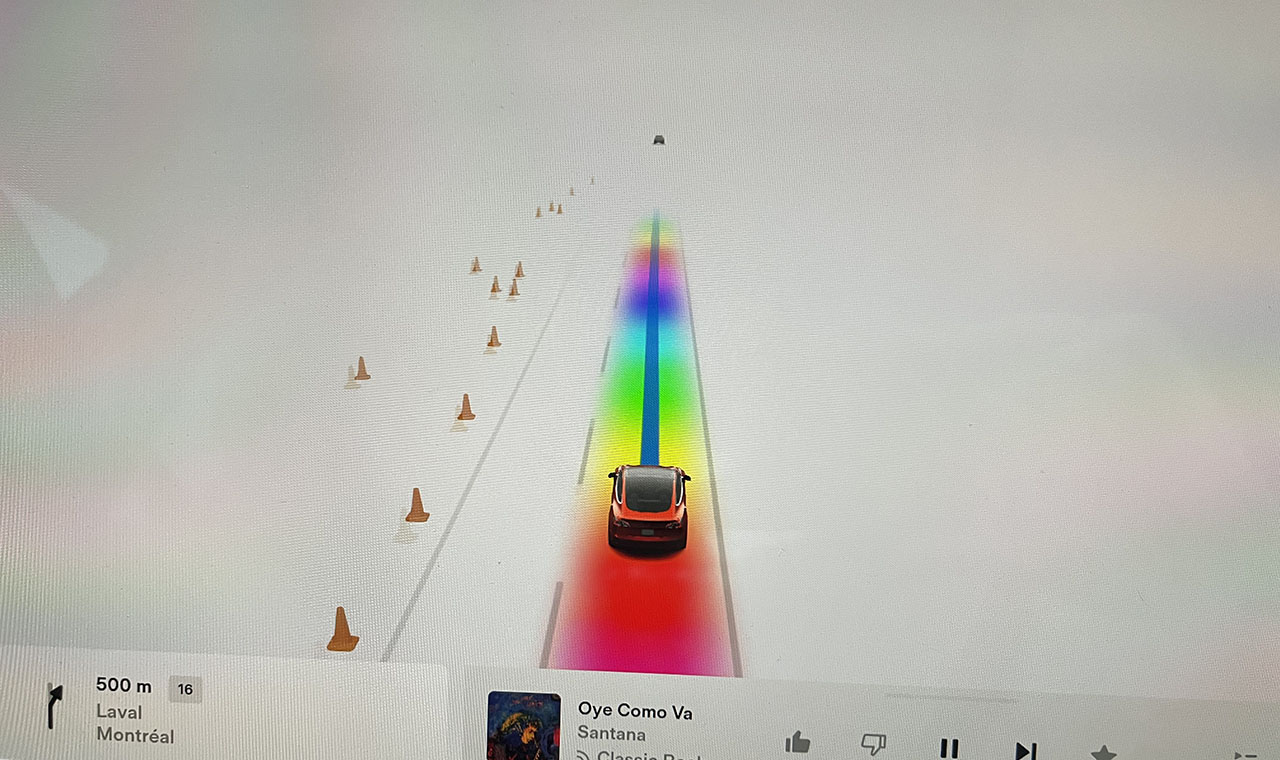
My first disengagement was due to some construction on the road that was taking the car off-road, while the normal lines were still properly marked, which confused the Navigate on Autopilot, so I had to take over.
The second one was due to off-ramp access becoming 1 lane and some bad drivers forcing themselves in from the shoulder. Since the car was slowing way down to let them go through, I didn’t fully trust the other drivers coming behind us, so I took over for safety.
Finally, the last time was caused by the strange intersection and the fact that we were looking for the restaurant where we were going not being too visible from the street and we need to make a sharp turn, then a U-turn. Something that FSD beta is capable of doing as of yet. The stacks don’t include turning into driveways, or parking lots just yet.
Overall, the system performed almost flawlessly, the drive to our destination was smooth and allowed me to feel less stressed and tired upon our arrival.
Coming back to Montreal
On the way back, we drove to a Supercharger and planned our trip back. After looking again at ABRP, our estimate was roughly 7 hours 57 minutes (695km). Following the same rule as when we started, I think it would be safe to estimate that it would take 30 minutes less to drive with an ICE car.
We did 1 extra stop at an EN ROUTE for a necessary bathroom break! Which added another 15 minutes.
FSD and FSD beta in traffic
Standard Navigate on Autopilot worked flawlessly again. As for FSD Beta, we didn’t get to use it much as the Superchargers were close to the highway, and the stack was used in most of our destinations. No disengagement on the way back… actually, we had 1. On a short stretch, we had to go from highway speed to 60 km/h very quickly as there was a construction zone that had extremely narrow lanes and it felt safer to take over rather than testing the limits with the whole family in the car.
Final cost of the trip?
On our way to Ste-Catherine, we need 4 charges. We technically only needed 3 but I didn’t feel like waiting on a 150kw providing only 72kw due to high occupancy and there was a 250kw down the road, which knowing earlier, I would have driven straight to it.
So for the first part of the trip, we ended up having a total cost of 53.69$ for a 1-way trip. Which is really not bad considering that it was a 692 km drive.
For the second part of the trip, we drove to the Supercharger in Niagara Falls (250kw). From there we used 3 other Superchargers totaling a cost of 81.07$. Again, it was acceptable for a 695 km trip back home.
in the end, our roundtrip cost us a total of 134.76$, for 1377 km of driving. which translates to 0.098$ per kilometer. I don’t think we could have achieved the same efficiency with an ICE car. It did take us about 2 hours more for a roundtrip but we saved on cost, driving was a breeze, and all things considered, we got to see the landscape. Everyone is always in a rush to get everywhere and anywhere, so why not take the time to breathe and live and take the time it takes between places?