
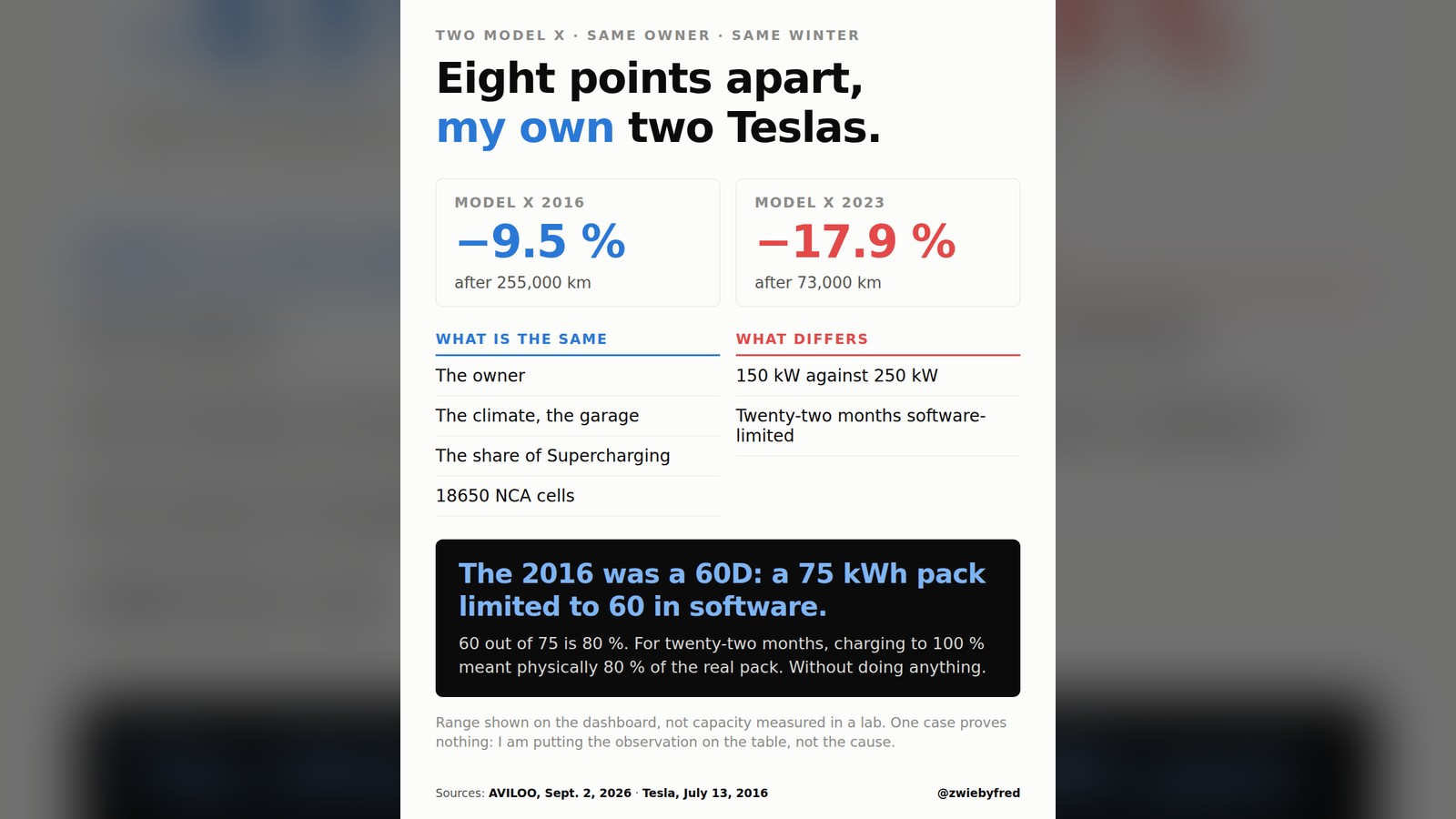
For twenty-two months my Tesla never charged past 80 percent of its real battery. That was not a good habit on my part, it was a software limit, and I only worked it out while writing this.
AVILOO, an independent Austrian lab, published more than 500,000 battery tests on September 2, run between 2022 and 2026 across 20 models and four continents. The headlines went to the model ranking. The result I care about is the spread: up to 13.5 points of state of health between the best and the worst example of the same model. On a Model Y at 150,000 km, from 82.9 percent to 94.9. Knowing the average lands at 90.3 tells you nothing about the specific car sitting on the lot.
I have both ends of that spread in my own driveway. Two Model X.
The 2016 had 255,000 km on it when I sold it, still showing 345 km of range. New, that pack gave 381. Nine and a half percent lost in just under seven years. The 2023: 73,000 km, 560 km at delivery, barely 460 today. Around 18 percent in two years and nine months.
Same owner, same garage, same Quebec winter. Same split between Supercharging and level 2 at home, I never changed how I charge. Same cell format and chemistry, 18650 NCA in both. Two things differ. Fast charging peaked around 150 kW on the 2016 and hits 250 on the 2023. And the 2016 was a 60D, which is not a 60 kWh pack, it is a 75 kWh pack limited in software to 60. Tesla announced it on July 13, 2016: 200 miles EPA in the 60D, 237 in the 75D, and C$9,000 to unlock the 15 kWh already sitting there. Sixty out of seventy-five is 80 percent. Every time I charged to 100, the pack was physically at 80.
I went back to my own dates before writing that the limit had protected it, and the numbers say the opposite. Delivered January 11, 2017, unlocked November 22, 2018 at 67,300 km. While limited it lost 3.9 percent in one year and ten months, about 2.1 percent a year. After unlocking, another 5.7 percent spread over five years, about 1.1 percent a year. It aged twice as fast while it was limited. That looks like the ordinary battery curve, steep early and flatter later. So no, I cannot tell you the buffer saved it. My own numbers do not show it, and I am not going to invent an answer.
What I can do is compare the two at the same age. I sold the 2016 to Tesla on December 15, 2023 and took delivery of the 2023 the same day, so the curves touch. At two years and nine months the 2016 was down about 5 percent with roughly 98,000 km. The 2023, at the same age, is at 18 percent with 73,000 km. Three and a half times the loss, on 25,000 km less. That 5 percent and 98,000 km are extrapolated from my reading of November 22, 2018. The direct measurement is 3.9 percent at 67,300 km.
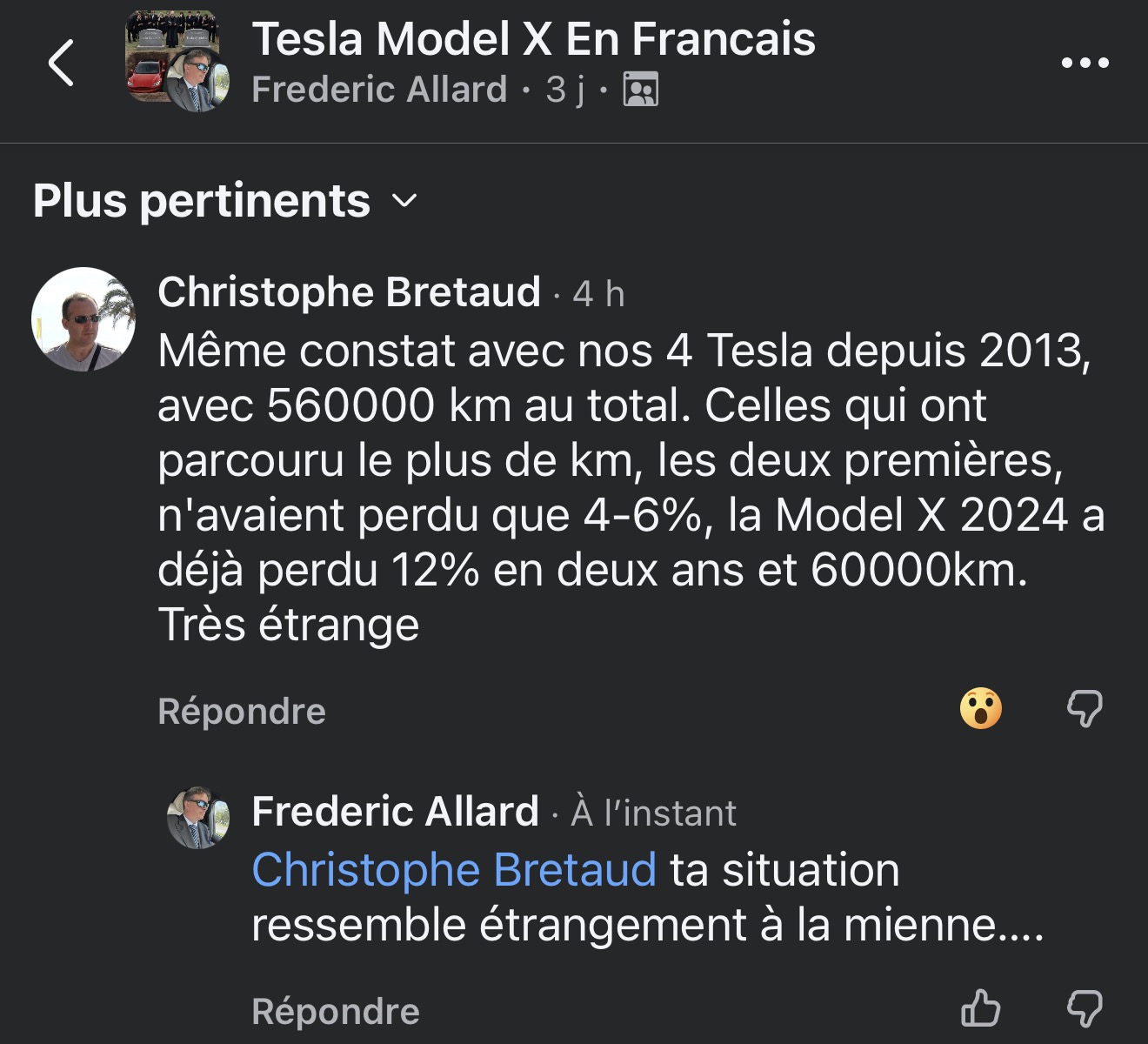
While I was writing this, a comment came in under one of my posts, and it belongs here. Christophe Bretaud has had four Teslas since 2013, 560,000 km all told. The two that covered the most distance are his first ones, and they were down only 4 to 6 percent. His 2024 Model X is already down 12 percent in two years and 60,000 km. He signs off with “very strange.”
Twelve percent in two years is 6 percent a year. My 2023 is at 6.5 percent a year. Same order of magnitude, somebody else’s driveway, same inversion: the older cars that drove the most are the ones aging the least.
Two things worth stating. I do not know how Christophe measures, and his 4 to 6 percent is not on Model X. That is not a study. It is two people instead of one seeing the same thing, and at this stage that is not nothing.
Why the newer one ages faster, I don’t know. The 250 kW? The cell lottery AVILOO puts at 13 points? Nobody publishes results broken down by chemistry, charge rate or climate.
AVILOO’s practical conclusion holds either way: get the battery tested before you buy a used EV. Test the car, not the model.
Sources: AVILOO release, September 2, 2026 · Tesla announcement on the Model X 60D, July 13, 2016 · Automobile Propre
What about you? I am looking for cases comparable to mine. If you owned an older generation of a model and you are driving the recent version of that same model today, Model X, Model S, Leaf, Bolt, whichever, I want to hear your experience. Give me both your range losses and both your odometer readings, and we will see whether it lines up.