
Part 2 of 6 on batteries. Wednesday was the price. Today: how long it lasts in the car, and what happens when the range starts dropping.
Start with the myth. “After ten years your battery is finished.” No. After ten years your battery has changed jobs.
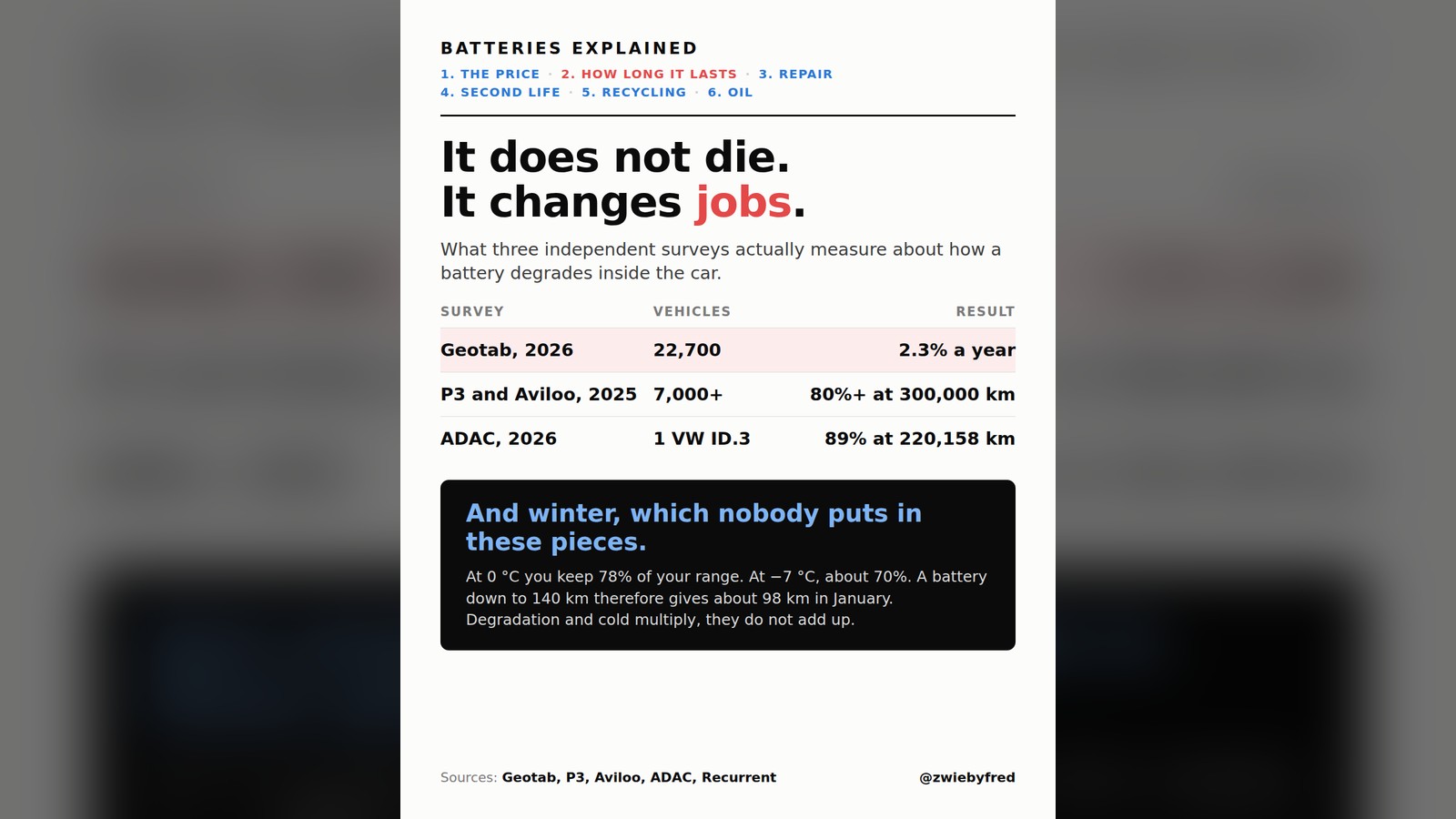
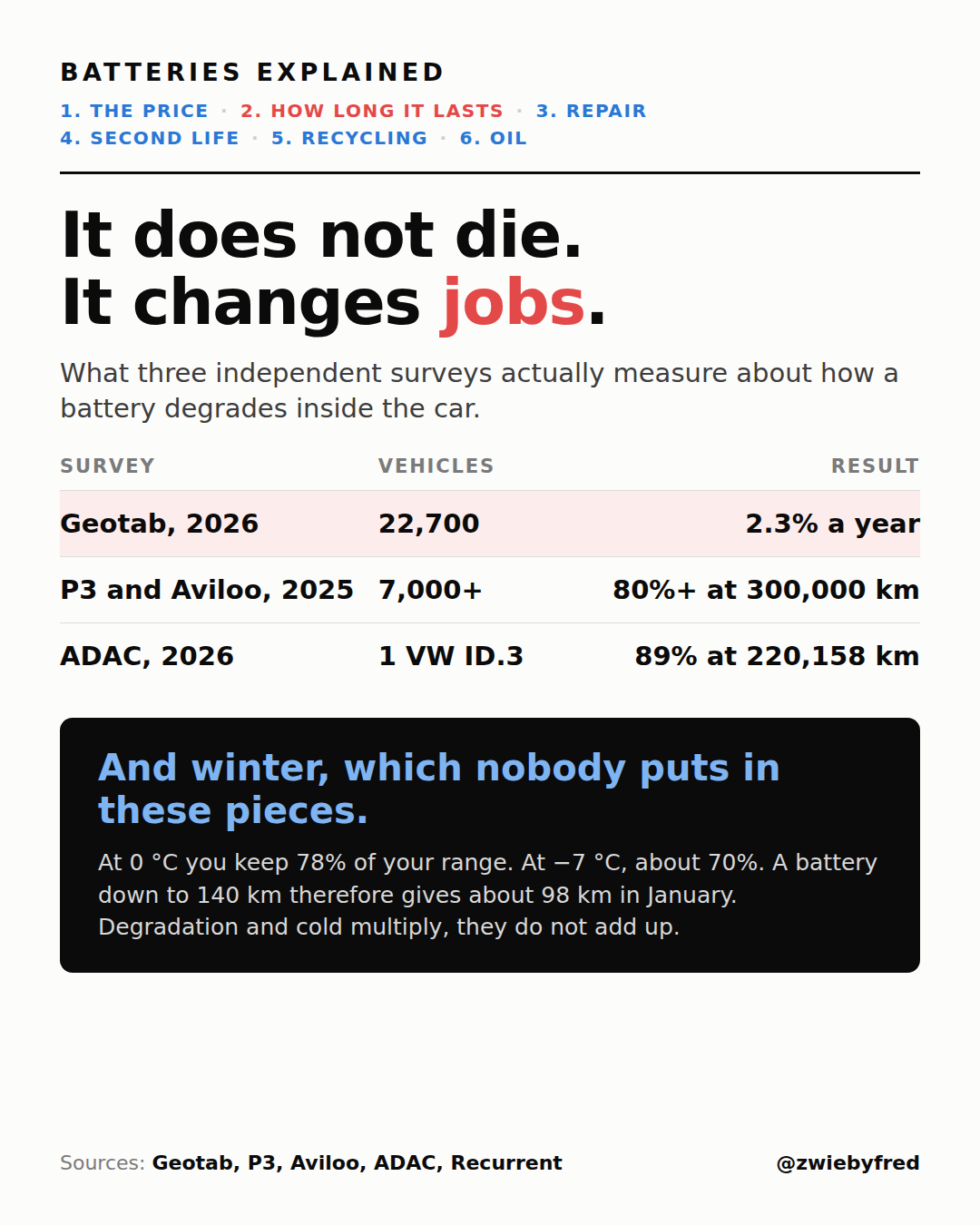
The most solid number out there comes from Geotab, which tracks fleets through telematics. Last April, across 22,700 electric vehicles and 21 models: average loss of 2.3% a year, and 81.6% of original capacity after eight years.
Here is a detail I have not seen reported anywhere, and it matters. In 2024, on 5,000 vehicles, Geotab was announcing 1.8% a year and headlines said “20 years or more.” Everybody ran with it. With a sample four and a half times larger, Geotab went back up to 2.3%, exactly its 2019 figure. So if you still read “1.8%” or “20 years” somewhere, know that the author itself revised that number.
Two more surveys, so this does not rest on one source. P3 and Aviloo, June 2025, more than 7,000 vehicles out to 300,000 km: most keep over 80% of their capacity even after 300,000 kilometres. And Germany’s ADAC ran a VW ID.3 for 220,158 km over five years: from 96% state of health at 21,749 km down to 89%.
The curve drops faster in the first years, then it settles. All three surveys say so. My two Model X said the same thing, if you remember the September 10 piece.
The one usage factor clearly measured is fast charging. Geotab again: vehicles where more than 40% of sessions exceed 100 kW lose 3.0% a year. Light users of fast charging, 1.5%. Double, on the same car.
Now let’s take the worst case. Darker than anything the surveys show. Say a car that started at 400 km of range and is down to 140 after fifteen years. I will say it straight away: no fleet data shows a loss like that. At 2.3% a year you would land closer to 280 km. But let’s deliberately take the most depressing scenario.
140 km. Is that finished?
Statistics Canada, 2016 census: the average car commute in this country is 18 km one way, with a median of 8 km. Double it for the round trip, that is 36 km on average. The U.S. Department of Energy measured that 73% of all trips are 16 km or less, and 98.6% are under 121 km. And in a two-vehicle household, the second car drives less than 60% of the first, about 56 km a day.
So no, 140 km is not finished. That is a student’s car. That is the family’s second car for neighbourhood errands. It is perfectly functional for just about everything people do in an ordinary day.
There is one thing I am not going to hide from you, though, and it is exactly the one the reassuring pieces always leave out. Cold. Recurrent measured this across more than 30,000 vehicles and 34 models: at 0 °C you keep 78% of your range. At −7 °C, about 70%. A heat pump gives you back roughly ten points at 0 °C.
Do the math with me. A battery down to 140 km of nominal range, in January at freezing, gives you about 98 km. Degradation and cold do not add up, they multiply. That is the real number for somebody who lives here, and I would rather give it to you myself.
Last point, and this is where I will be most honest with you: is it time or is it kilometres that wears a battery down? The data contradicts itself.
The European Commission’s Joint Research Centre lab-tested a 2015 vehicle with 9,050 km on the odometer. Nine thousand. After six years and eight months it was at 73.4% of capacity. Barely driven, a quarter of the battery gone. That is time.
But Environment and Climate Change Canada ran the opposite experiment, and nobody covered it. Two identical vehicles, same model, same trim, built seven months apart, both eight years old. The first at 13,903 km: down 8%. The second at 176,200 km: down 19.9%. The authors conclude that mileage matters more than calendar ageing.
Two serious studies, two opposite conclusions. I am not calling it, and be wary of anyone who does.
On Wednesday, part three: repair. Because when a battery has a problem, you do not swap the whole pack, and that changes the entire calculation.
What about you? At what range does a battery become unusable for the way you actually drive?
Sources: Geotab, 22,700-vehicle analysis, April 2026 · P3 automotive and Aviloo, EVS38, June 2025 · ADAC long-term VW ID.3 test, July 2026 · Recurrent cold-weather range study, November 2025 · Statistics Canada, 2016 census commuting data · U.S. Department of Energy, March and October 2024 · European Commission Joint Research Centre, September 2023 · Environment and Climate Change Canada, EVS38, June 2025