
Part 3 of 6 on batteries. Saturday was how long it lasts. Today: what happens when something goes wrong.
The myth is well established. One cell fails, and you are quoted a whole new pack, at the price of a used car.
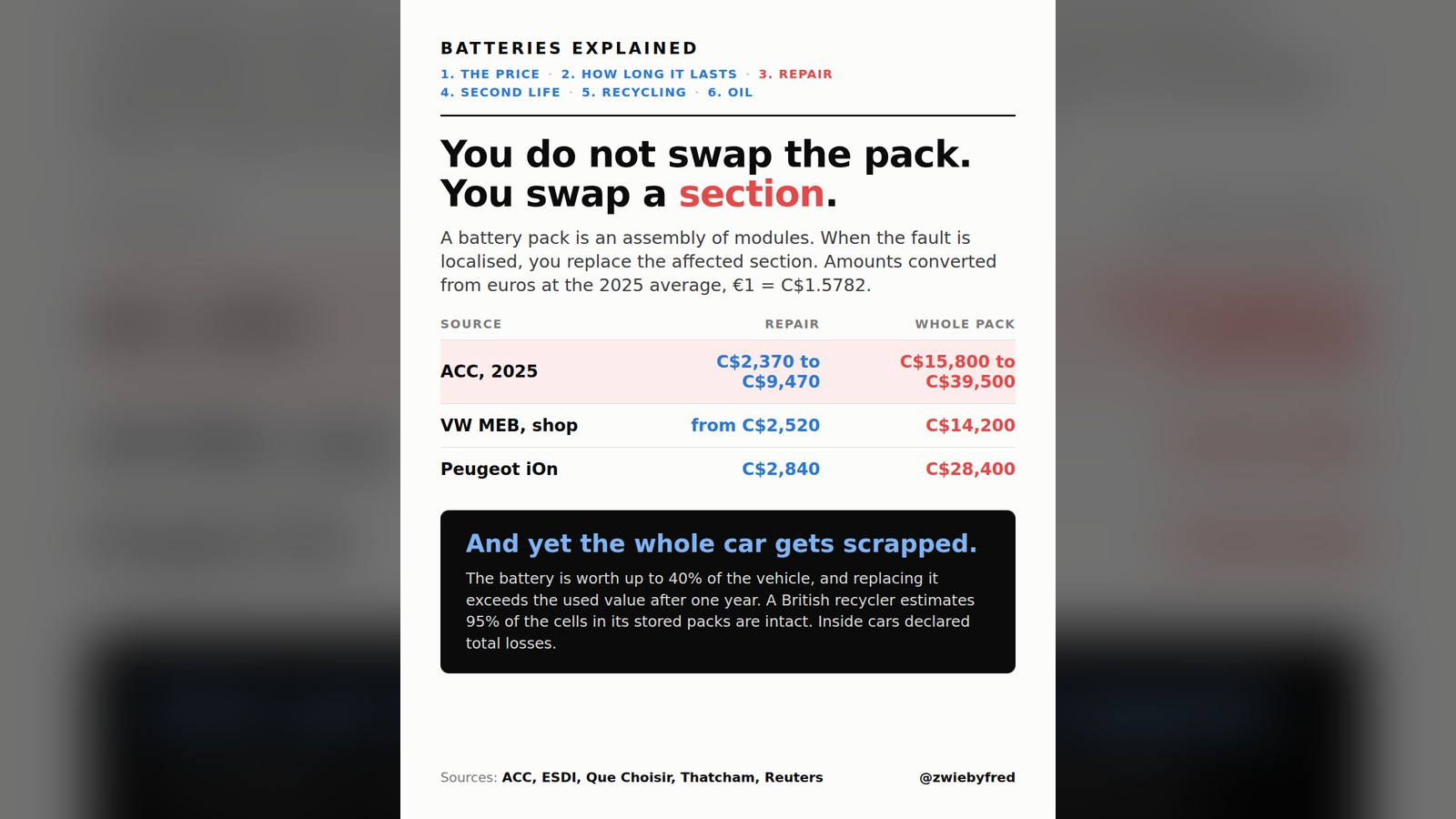
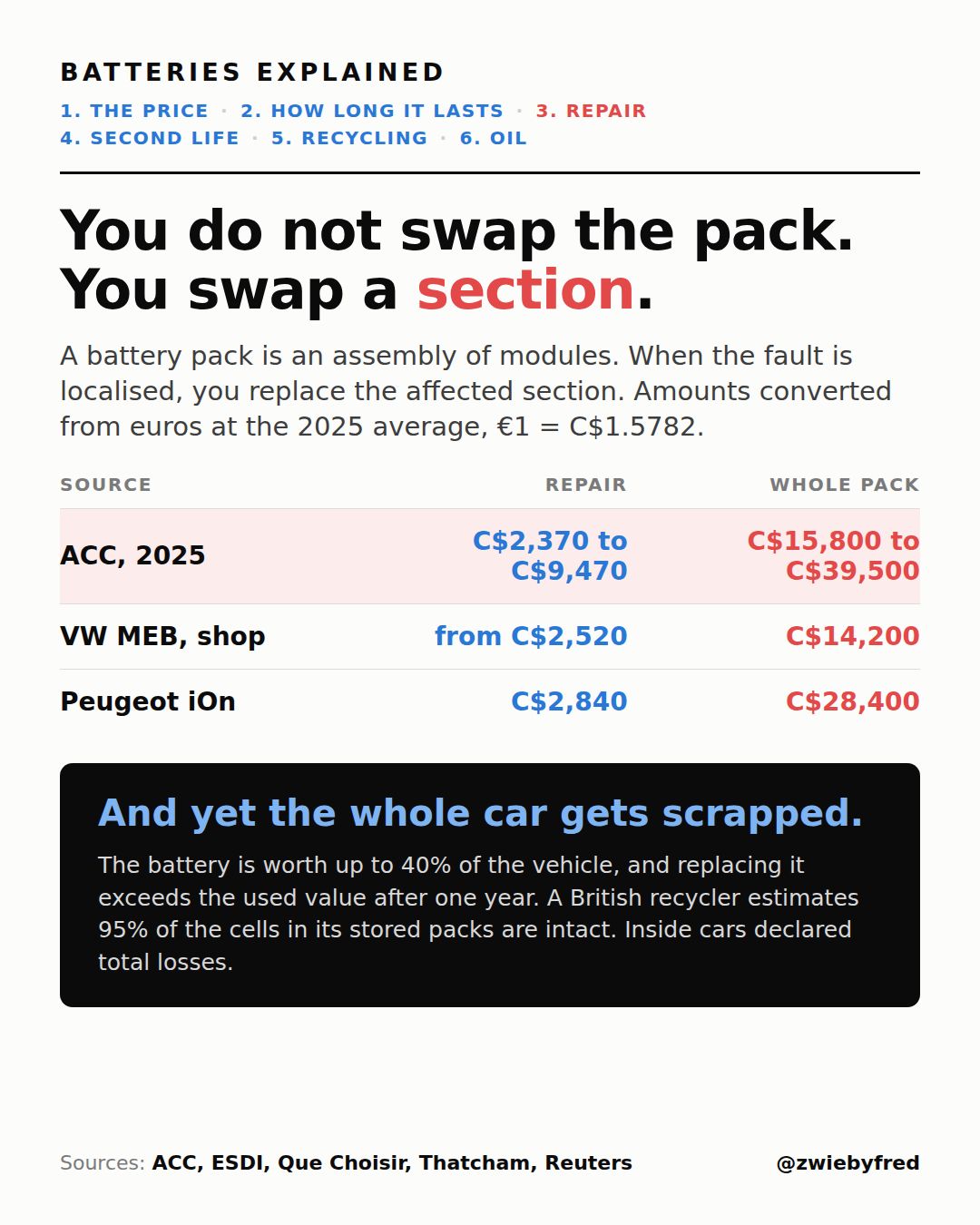
That is not how it works technically. A pack is an assembly of modules, and a module is a bundle of cells. When the problem is localised, you replace the affected section, not the other fifteen.
The prices speak for themselves. Automotive Cells Company, the cell joint venture of Stellantis, Mercedes and TotalEnergies, gives the European orders of magnitude. I convert to Canadian dollars at each figure’s own year average Bank of Canada rate, with the original amount in brackets. A module, C$2,370 to C$9,470 (€1,500 to €6,000). The full pack, C$15,800 to C$39,500 (€10,000 to €25,000).
A German shop, ESDI, posts its prices on MEB platform packs, the ones under the VW ID.3 and ID.4: a module from C$2,520 (€1,599), the full pack C$14,200 (€8,999). Three to five working days, twelve-month warranty on what was replaced.
And France’s UFC-Que Choisir documented cases last year. A Peugeot iOn: dealer quote C$28,400 (€18,000). At a specialist shop, C$2,840 (€1,800). A 2014 Range Rover hybrid: C$50,500 (€32,000) at the dealer, C$13,400 to C$14,200 (€8,500 to €9,000) elsewhere.
This happens for real, and not at the margins. When GM recalled 73,000 Chevrolet Bolts in 2021, it did not replace 73,000 packs. It replaced the defective modules, for about C$1.25 billion (US$1 billion). Volkswagen did the same last April across 94,000 vehicles: inspection, software update, and replacement of only the out-of-spec modules.
CATL, the largest cell maker in the world, went further in August: a repair network working at the cell level, eight of its own centres in China, two international ones in Norway and Istanbul, and 1,376 franchised centres across 84 countries. Their promise is to cut the cost tenfold. That is an announcement, not a price list yet, so I take it with tongs.
It exists here too. Distribution Côté et fils has built a full diagnostic protocol. NexDrive, the UAP network, offers to replace one or more modules rather than the pack. Neither publishes prices, and I wish they would.
Now I am going to be honest with you, because this is where my piece diverges from what I would have liked to write.
Module-level repair is not the norm yet. I thought it was. The sources say no.
Allianz’s technical centre wrote in December 2023 that the lack of repair instructions and service parts leads to an “inevitable replacement of the battery pack.” And Thatcham Research, the British insurers’ research centre, published an eight-point plan last March to make batteries repairable. If that has to be published in 2026, it is because the problem is not solved.
And it gets worse. Thatcham calculates that the cost of replacing a battery exceeds the used value of the vehicle after only one year. The battery accounts for up to 40% of the car’s value. The result is that an electric vehicle whose battery is touched in a collision is often written off entirely.
British recycler Synetiq told Reuters what that looks like in its yard: it estimates that 95% of the cells in the hundreds of packs it has in storage are intact. Good batteries, inside cars that were declared total losses.
So when people say the battery outlives the car, that is true. But in these cases it is true for the wrong reason.
One last thing, and it worries me for what comes next. ACC writes it plainly: the more modules a pack has, the more repairable it is. Yet the industry is moving toward module-free packs glued into the chassis. Sandy Munro, who takes cars apart for a living, calls the Model Y structural pack “zero repairability.” Repairability could go backwards rather than forwards. That is the kind of thing worth saying now, not in five years.
Two clarifications for anyone about to quote regulation at me. The EU battery regulation does require replaceability, but its Article 11 does not cover electric vehicle batteries: the Commission said so in its January 2025 guidelines. And the EU right-to-repair directive does not cover cars either. In Canada, Bill C-244 lifts a copyright lock, but it obliges nobody to sell you a part.
On Saturday, part four: what happens to the battery once it leaves the car for good.
What do you think? If your shop offered to repair a section instead of swapping the whole pack, would you trust it?
Sources: Automotive Cells Company, July 10, 2025 · ESDI EV Technologies · UFC-Que Choisir, April 8, 2025 · General Motors release, August 20, 2021 · CATL announcement, August 14, 2026 · Autocraft Solutions Group · Autosphere, January 31, 2025 · Allianz Zentrum für Technik, December 14, 2023 · Thatcham Research, July 5, 2023 and March 2, 2026 · Reuters, March 20, 2023 · European Commission guidelines C/2025/214, January 10, 2025 · Bank of Canada annual average exchange rates