
Part 4 of 6 on batteries. Wednesday was repair. Today: what happens to the pack when it leaves the car for good.
This myth is a friendly one. You hear it at every conference: the battery ends its life in a container storing electricity for the grid. Second life, circular economy, everybody applauds.
It is true. It exists for real. But it is small, and I am going to tell you why.
Start with what exists. B2U Storage Solutions, in California and Texas, is the largest second-life operator in North America. It brought a 28 MWh project online near San Antonio on September 9. In total the company runs about 100 MWh of storage and manages more than 5,000 repurposed EV packs.
In Nevada, Redwood Materials and Crusoe wired up 63 MWh of used packs to power a data centre. And in Canada, Moment Energy opened a repurposing plant in Vancouver at the end of June, built in six weeks, with Mercedes-Benz Energy supplying the batteries. Its target is 1 GWh by 2030. A target, not a reality.
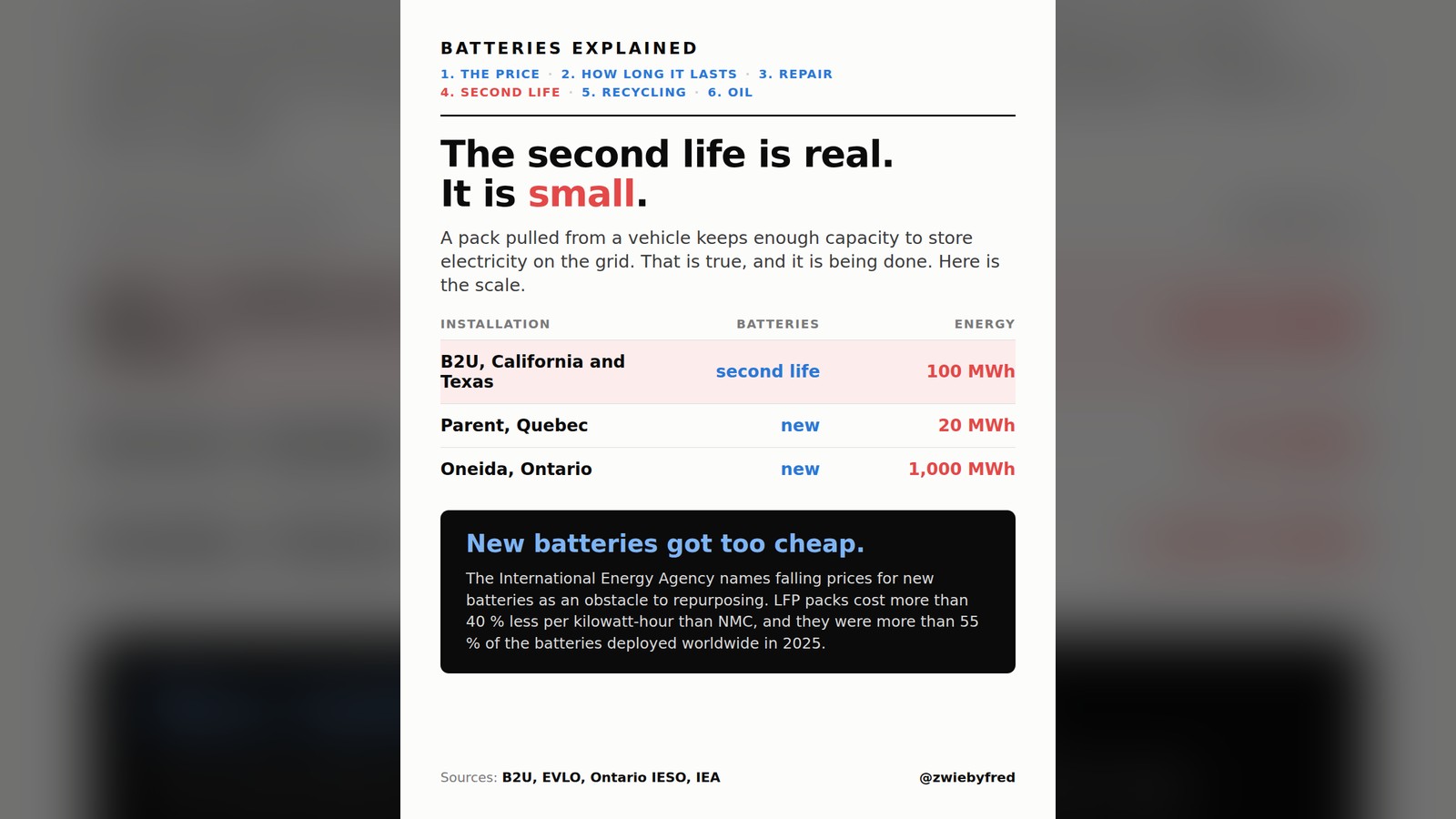
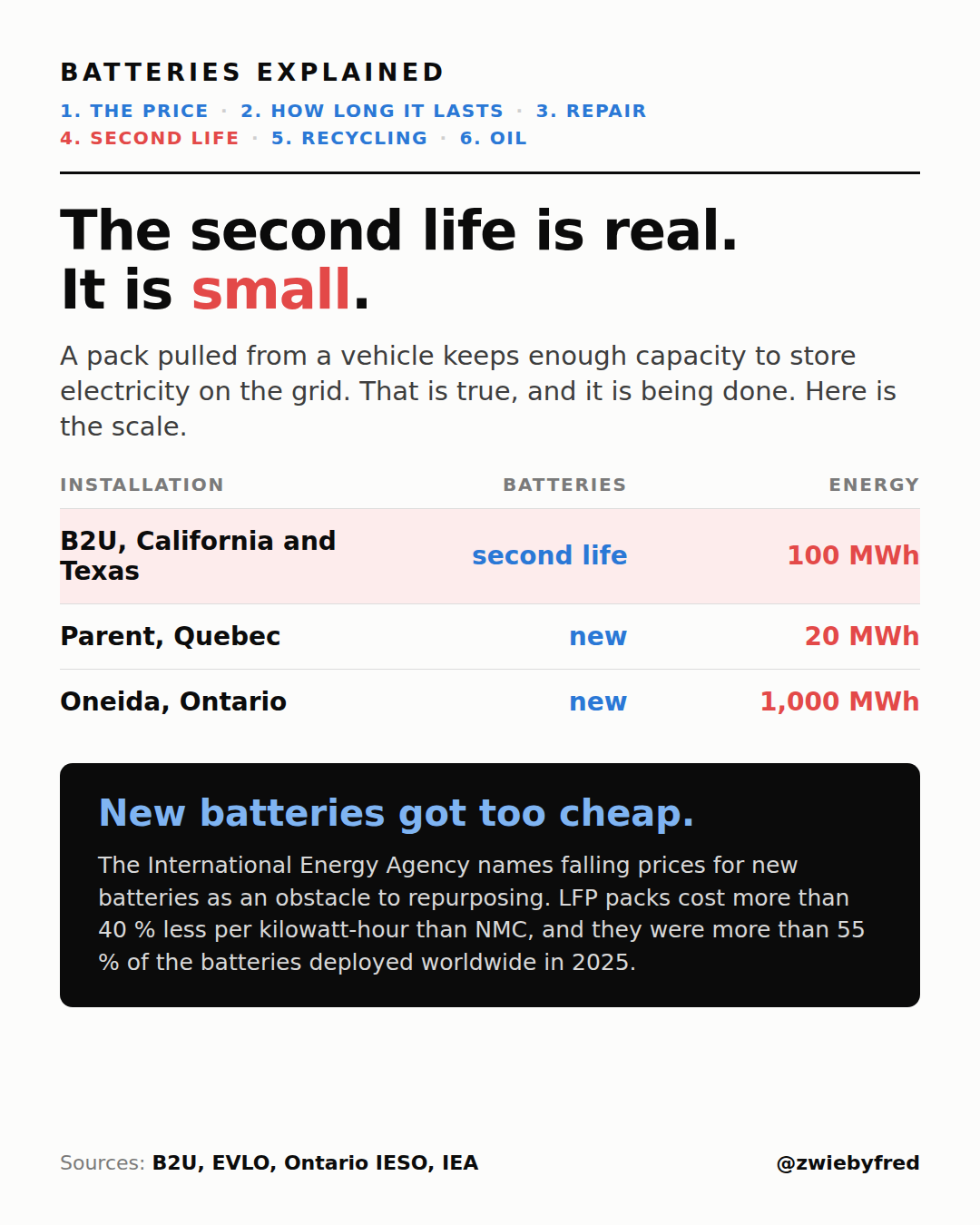
Now the scale, because this is where it gets uncomfortable. The largest second-life operator on the continent runs 100 MWh. The Oneida project in Ontario, one site, with new cells: 250 MW and 1,000 MWh. Ten times the energy, on its own, in commercial operation since May 8, 2025.
So why does it not take off? The International Energy Agency wrote it plainly last May: falling prices for new batteries reduce the economic attractiveness of repurposing. LFP packs now cost more than 40% less per kilowatt-hour than NMC, and they were more than 55% of the batteries deployed globally in 2025.
Put another way, new has become so cheap that dismantling, testing, sorting and reassembling old no longer pays.
A Stanford working paper from August 2024 splits the answer by chemistry. For LFP, a battery coming out of a car generally keeps more than 40% of the market value of a new one, so second life holds up. For nickel-cobalt chemistries the justification is only marginal, and for China the authors conclude you are better off recycling immediately.
Mercedes reached the same conclusion long before that, and walked away from second-life home storage around 2018: no economic benefit.
There is also something nobody knows. How long does a second life last? Five years? Seven? Ten? Operators said it out loud in London last autumn: as long as nobody knows, nobody can finance a project. A bank does not lend against an asset of unknown duration.
Nobody knows what share of packs takes that road either. The only sourced percentage I found dates from 2018: roughly half of end-of-life batteries never reach a recycler at all. Eight years is old. And forecasts of the volume available by 2030 differ by a factor of ten depending on who publishes them. When the experts cannot agree on the order of magnitude, it means nobody knows.
Now Quebec, and it is not a nice story.
No company here operates stationary storage built from used EV packs. EVLO, the subsidiary of Hydro-Québec, the province-owned utility, deploys new storage, not second life: its largest Quebec project, at Parent, is 4 MW and 20 MWh. On June 19 Hydro-Québec shut down the battery materials research at its centre of excellence, saying that work “no longer corresponds to Hydro-Québec’s role.” And its 2035 action plan speaks of “a few hundred megawatts” of solar and battery storage by 2035, with not a word about second life.
One thing I want to say in my own name, and I am giving it as a logical possibility, not a documented fact. A wind farm produces when the wind blows, not when you need it. In my head, that calls for storage somewhere.
So I went looking. What I found is that the storage exists, but it sits on the grid, not at the foot of the turbine. In Ontario the system operator contracted 1,784 MW of storage in one procurement and 880 MW in another, and I could not tie a single one of those projects to a wind farm. In Quebec the target is more than 10,000 MW of wind by 2035, while storage is counted in a few hundred megawatts, solar included.
So yes, there is storage. No, it is not attached to the turbines. And no, it is not second life: it is new.
On Wednesday, part five: recycling. Fair warning, I had a good news story prepared.
What do you think? Would a battery that did 300,000 km in a car reassure you sitting in a container next to a substation?
Sources: B2U Storage Solutions release, September 9, 2026 · Crusoe and Redwood Materials, June 26, 2025 · Moment Energy release, May 13, 2026 · International Energy Agency, Global EV Outlook 2026, May 20, 2026 · Stanford Graduate School of Business working paper 4203, August 2024 · Energy-Storage.news, Galp panel, October 1, 2025 · Circular Energy Storage for the World Economic Forum, December 2018 · Hydro-Québec release, June 19, 2026 · Hydro-Québec 2035 action plan · EVLO Parent project page · Ontario IESO, Oneida and the LT1 and E-LT1 procurements