
My wife and I have owned nine electrified vehicles over 25 years, and in all that time we did one oil change. Maybe. I am not even sure about that one.
This is two drivers, not one. She had the 2001 Insight, the three Leafs and the Fiat 500e. I had the 2010 Insight, the Volt, and the two Model X. She does the daily driving, I do the distance, and that turns out to matter for what follows.
The first thing 25 years of hand-written numbers taught us is that cold does not kill batteries the way people think, but heat does.
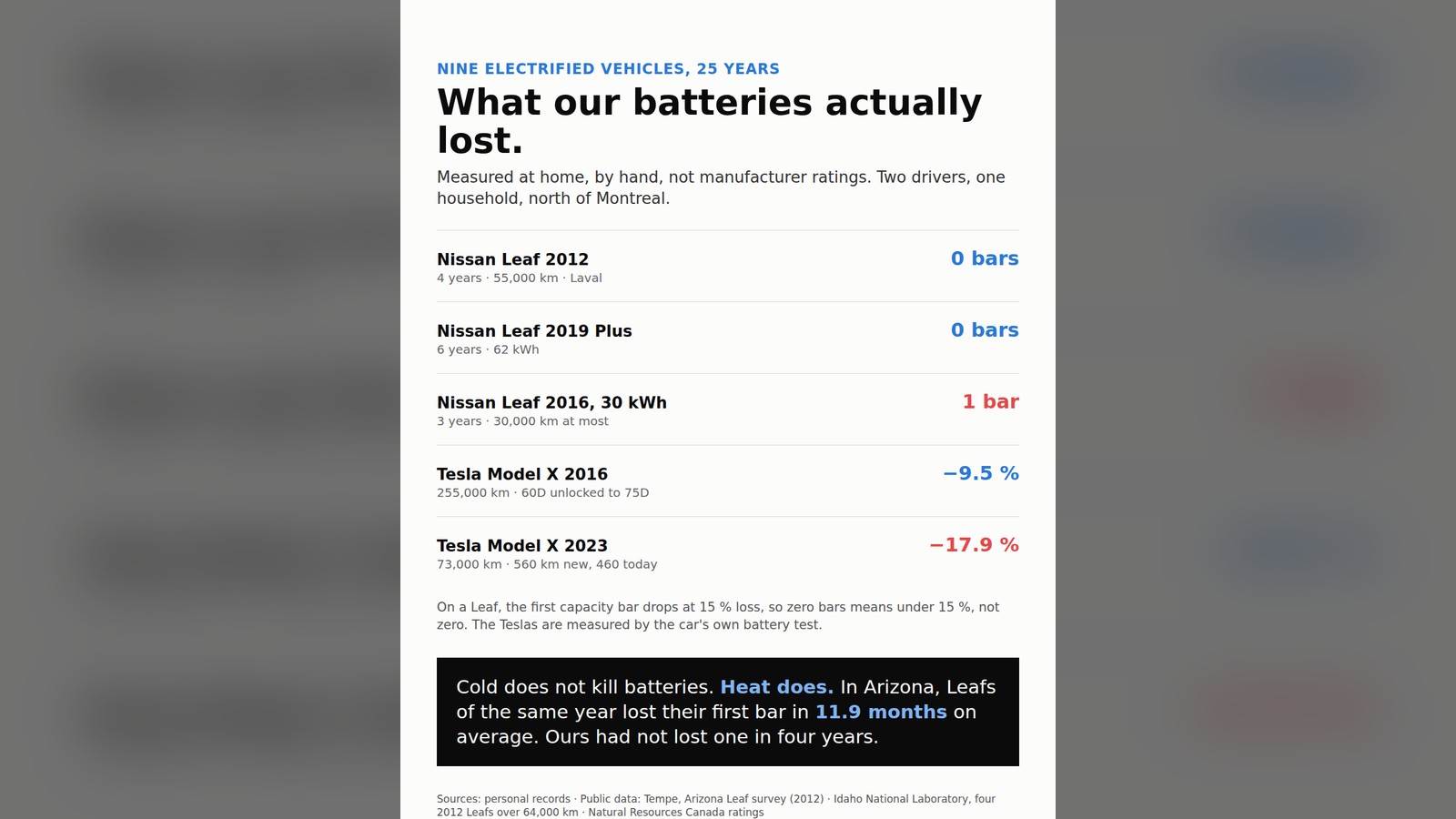
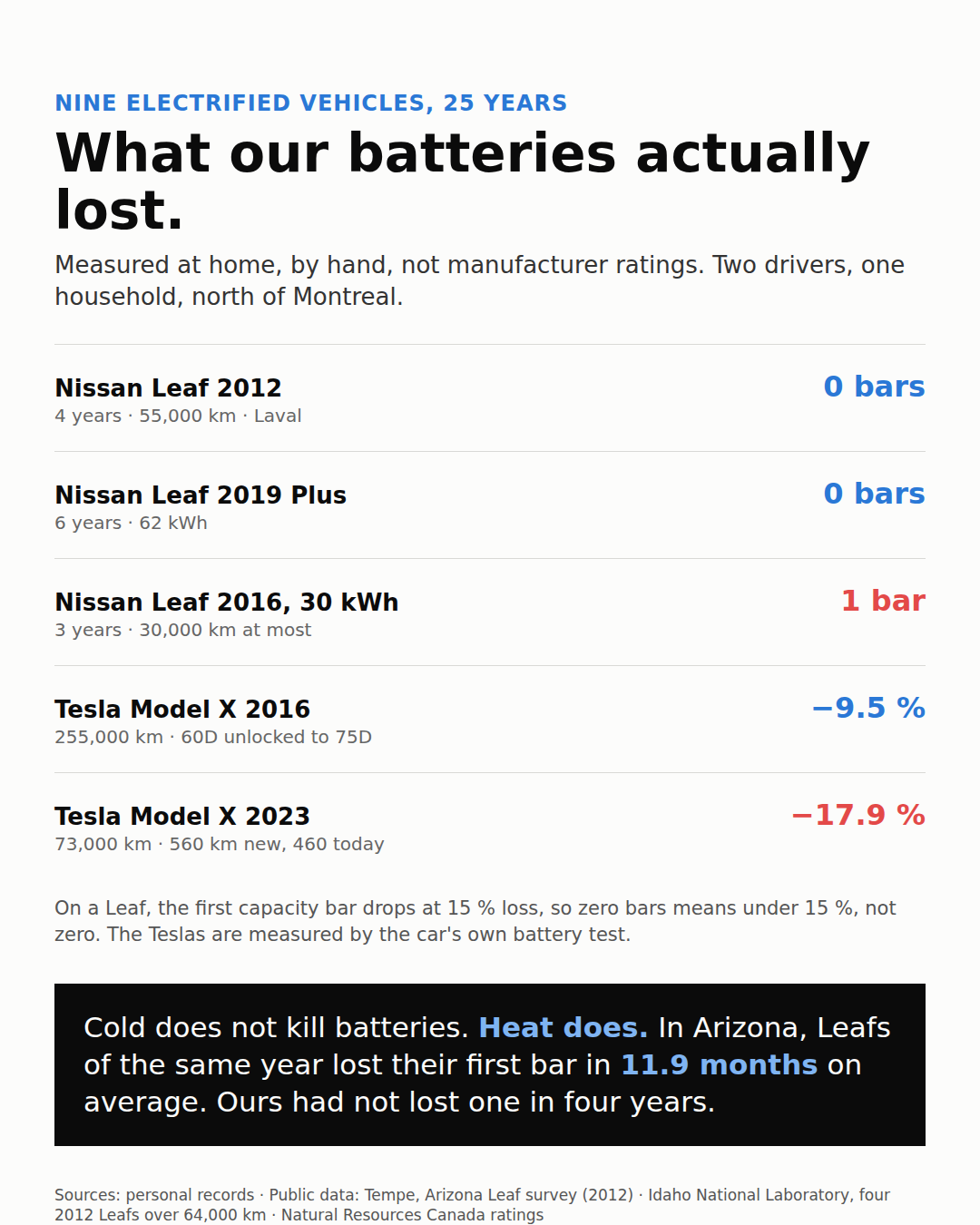
Our 2012 Leaf had no liquid cooling at all, like every Leaf of that generation, but it did have a battery heater for winter. Protected against the cold, not against the heat. In four years and 55,000 km in Laval, north of Montreal, it never lost a single capacity bar.
I have to be careful about what that means. On a Leaf, the first bar does not drop at the first percent lost. It drops at 15 percent, and each bar after that is worth 6.25 percent. So all I can honestly claim from the dashboard gauge is that we lost less than 15 percent in four years. Not zero, under fifteen. I never ran LeafSpy or any OBD reader on our Leafs, so I have no finer number and I am not going to invent one.
The comparison still holds, because it is the same instrument on both sides. In Arizona over the same period, a survey of twelve Leafs in Tempe found an average of 11.9 months before the first bar disappeared. That is more than 15 percent lost in under a year, while ours had not crossed that line in four. Idaho National Laboratory also followed four 2012 Leafs over 64,000 km, two charged at home and two on fast charging only, and found about three points of difference between the two charging methods. Ambient temperature mattered far more than how the cars were charged.
Same car, same year, same chemistry, same absence of thermal management. Two climates, two results that have nothing to do with each other. Almost all the degradation data circulating comes from hot climates, and I have never found a serious cold-climate study. So people apply numbers measured in Texas and Arizona to cars driven in Quebec, then wonder why the numbers do not match what they see.
The result I did not expect is that our older Tesla has aged better than the newer one.
The 2016 Model X was bought as a 60D and showed 325 km when it was new. About two years later it showed 310. I used my Tesla credits to unlock it to 75D and it went up to roughly 366 km rather than the 381 on paper. At the end, in 2023, with about 255,000 km on it, around 158,000 miles, it still showed about 340. That is 9.5 percent lost after a quarter of a million kilometres.
The 2023 Model X was built in September and delivered in December. It showed 560 km at full charge the day I got it. Today, at 73,000 km, on an optimized full charge, I barely reach 460. That is 17.9 percent, and it is not me doing arithmetic in my kitchen: it is the car’s own battery tester, still measuring against the original 560.
Same owner, same charging habits, same model, seven years apart, and the newer one degraded twice as fast over three and a half times fewer kilometres. I do not have a definitive explanation. Different chemistry, higher density, different thermal management. I am giving you the number, not the theory.
One more pattern, and this one annoys me. Twice in twelve years I have been sold a range figure that was lowered afterward. The 2012 Leaf was advertised at 160 km and Nissan later dropped it to 130, because the 160 came from the city cycle while the combined rating was 117. The 2023 Model X was at 560 km when I took delivery, and a few weeks later Tesla changed the number on its site to 530. Two manufacturers, twelve years apart, doing exactly the same thing. That is not degradation, it is a spec sheet revised after the sale, and those are two different problems, but from the buyer’s chair they feel similar.
And no, not everything went well. The 2016 Leaf, the 30 kWh one, is the worst we have owned: one capacity bar gone in three years and 30,000 km at most. If I told you nine out of nine were perfect you would be right not to believe me. The 2019 Leaf Plus, 62 kWh, went six years without losing a bar, but the person who bought it from us resold it a few years later and the range had started dropping fast. Degradation is not a straight line. It stays flat for a long time and then it lets go.
The newest one is the Fiat 500e, my wife’s car, the one we take when we are not going far. Its official rating is 240 km. We get 247 in summer and 200 in winter, so it beats its rating in summer and loses under 20 percent in winter, which is good for a small car when most people expect 30 or 40. I cannot tell you anything about its fast charging, because in two years and 7,000 km we have never once done it. For a second car the fast charger is useless, and that is information too.
Where all this lands, after 25 years, is that we did not end up with one big vehicle that does everything. We ended up with two tools, one for distance and one for daily life. That is exactly the same conclusion we reached in 2011, except that both of them are electric now.
Do your degradation numbers look like ours, or have you seen worse?