
You have all seen the list. “6,000 products are made from petroleum.” It shows up on posters, in comments, in slide decks. I have seen serious people cite it.
So I went looking for the source. It exists. And it is delicious.
The most-cited page belongs to Ranken Energy, a private drilling company in Oklahoma whose website otherwise speaks to investors. It publishes 144 items. Not 6,000. And it states, in its own words on that same page, that the list came from a print publication in 1974, that it failed to identify the source document, and that it has never been able to find the list of 6,000 items since. Its own conclusion: if you want the complete list, you will most likely have to compose it yourself.
The most repeated number in the energy debate is a lost 1974 brochure.
The real number is verifiable, and it is more interesting. According to the International Energy Agency, 15.8 % of the world’s oil does not burn. It becomes material. And that share is climbing: the IEA writes plainly that petrochemicals become the dominant source of global oil demand growth from 2026 onwards. More than one barrel in six by 2030.
Which means this. Even if every car went electric tomorrow morning, oil would stay. Not in the tank. In the garbage.
So I am starting a series of three. Not to claim petroleum never did any good, which would be false and you would spot it immediately. The opposite. Take each real advantage, show the drawback welded to it, and name what already exists to replace it.
One rule keeps coming back, and it holds the whole series up.
What makes the product convenient is exactly what makes it eternal.
THE STRAW
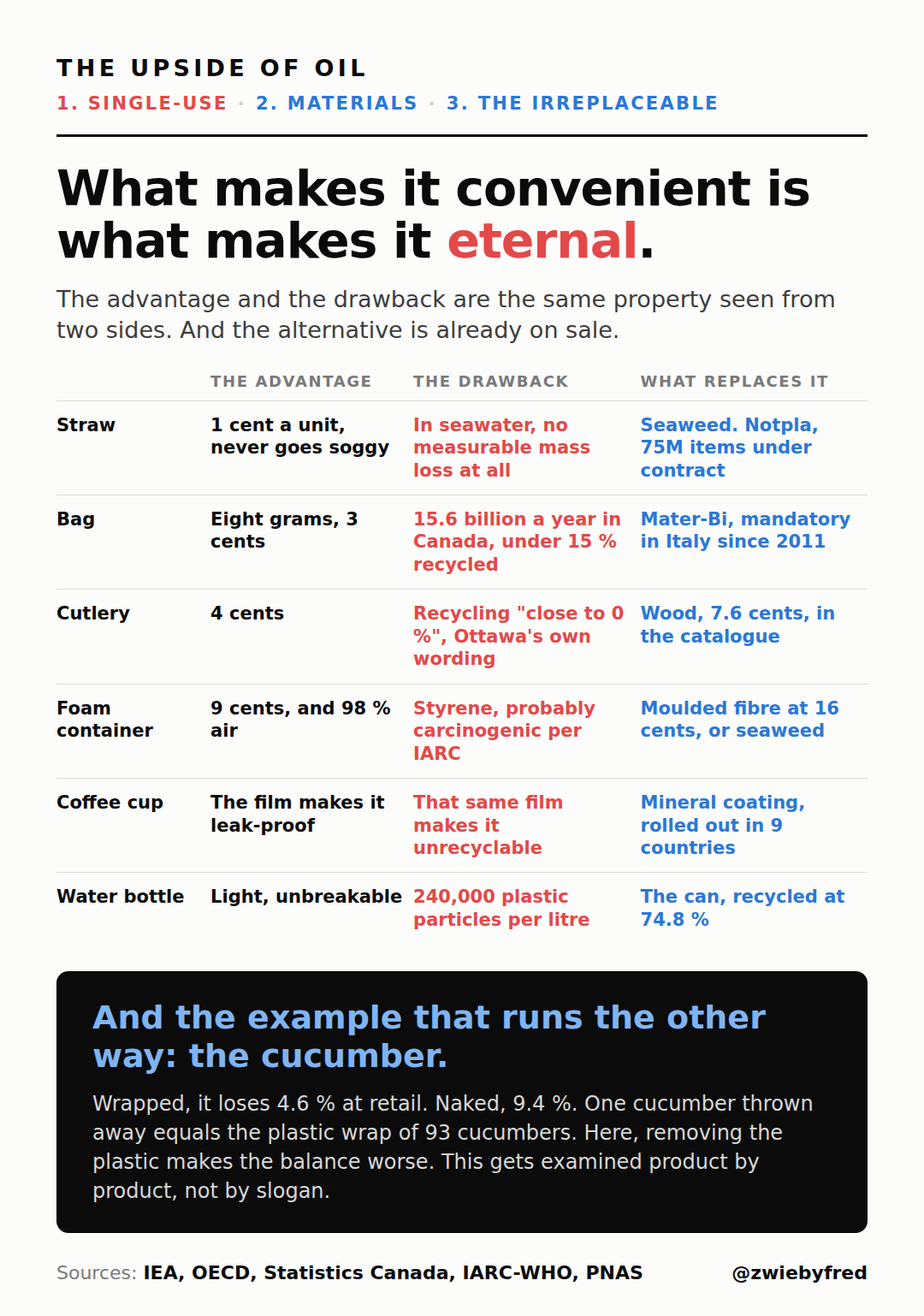
The advantage: one cent a unit against three cents for paper. It does not go soggy. And there is a use we forget when we campaign: the flexible straw is a real medical tool, and the Canadian regulation carries an explicit exemption for hospitals and long-term care. A blanket ban penalizes disabled people. That is part of the file.
The drawback: a team immersed straws in coastal seawater and measured actual mass loss, not a theoretical lab number. Paper disappears in about ten months. Cellulose diacetate in about twenty. Polypropylene and PLA, the one sold to you as a bioplastic, showed no measurable mass loss at all. None. Meanwhile a sea turtle that has swallowed 14 pieces of plastic has a one in two chance of dying from it, and 99 % of seabird species will have ingested plastic by 2050.
The alternative: Notpla, in London, makes containers and cutlery from seaweed. Not a prototype: a 75-million-item contract over three years with Levy UK + Ireland, more than 16 million items already replaced across ten European markets, 20 million pounds raised in 2024, Earthshot Prize winner. We are not condemned to soggy cardboard that tastes like soggy cardboard.
THE BAG
The advantage: eight grams, three cents.
The drawback: 15.6 billion a year in Canada. Fewer than 15 % are recycled.
The alternative, and here I go against the reflex: it is not the cotton bag. The Danish Environmental Protection Agency calculated how many times each bag type must be reused to beat a thin plastic bag. Paper: 43 times. Non-woven polypropylene: 52. Cotton: 7,100. Organic cotton: 20,000. Your tote bag needs to work every single day for twenty years. The study excludes marine litter, so it is not a free pass for plastic, but it says something important: the winner is the bag you keep, not the bag you collect. And for the single-use that remains, Italy settled it back in 2011 with mandatory compostable checkout bags in Mater-Bi, 150,000 tonnes a year of capacity.
THE CUTLERY
The advantage: four cents.
The drawback: 4.6 billion units a year in Canada, 11,112 tonnes, and a recycling rate the government itself describes as “close to 0 %.” That is the wording in the Canada Gazette.
The alternative is on sale, with the price posted. Wooden knife: 7.6 cents. Fork: 8.5 cents. Double the plastic. On a meal, that is three cents.
THE FOAM CONTAINER
The advantage: nine cents, and 98 % air, which explains both the price and the insulation.
The drawback: styrene is classified as probably carcinogenic to humans by the World Health Organization’s International Agency for Research on Cancer. And once it has burst into white beads in a ditch, it cannot be picked up.
The alternative: moulded fibre at 16 cents, and Notpla’s seaweed-coated containers. Europe banned foam food containers in July 2021.
THE COFFEE CUP
This one sums up the whole series by itself. The thin polyethylene film bonded inside the board is what keeps your coffee from going through the cup. That is a real function, not a whim. And it is exactly that film that makes the cup unrecyclable in almost every pulp mill.
The alternative exists and is deployed: since May 2025 Starbucks has been rolling out a cup in Europe whose plastic liner is replaced by a mineral coating. Finnish board, Italian coating, Welsh manufacturing, certified home compostable. Italy, Germany, France, Sweden, Switzerland, Austria, Spain, Portugal, Hungary.
THE WATER BOTTLE
The drawback was measured in January 2024 and published in PNAS: about 240,000 plastic particles per litre of bottled water, 90 % of them nanoplastics, 10 to 100 times more than earlier methods could detect. The bottle’s own PET is among them.
The alternative is not exotic: the can. Global recycling rate for aluminium beverage cans, 74.8 %. PET, 47 %. In North America, PET bottles drop to 29.1 %.
AND NOW THE EXAMPLE THAT CONTRADICTS EVERYTHING I JUST WROTE
The cucumber.
Wrapped in its film, it loses 4.6 % at retail. Naked, it loses 9.4 %. The authors calculated that the environmental benefit of the food saved is 4.9 times greater than the impact of the packaging. And their bluntest line: one cucumber thrown away equals the impact of the plastic wrap of 93 cucumbers.
In this specific case, removing the plastic makes the balance worse.
I put that example in on purpose. Because if I handed you a list where plastic loses every single time, you would be right to be suspicious. This gets examined product by product, not by slogan.
TO CLOSE, THE NUMBER THAT HURTS
The OECD: 9 % of the world’s plastic recycled. That is 2019 data and it deserves to be dated honestly, but it is the latest official figure.
And Canada, with Statistics Canada’s 2021 data: we throw away 4,986 kilotonnes of plastic, 130 kg per person. We divert 1,319 kilotonnes to recovery, a respectable 26.5 %. Except that at the end of the chain, the recycled resin actually produced and ready to use is 365 kilotonnes. Out of 4,986. About 7 %.
The gap between 26.5 % and 7 % is the gap between what goes in the bin and what comes back as material.
Wednesday, part 2: polyester, tires, asphalt, paint and insulation. That one reaches your closet and your street.
Sources: IEA (Oil 2025), OECD, Statistics Canada, Canada Gazette, European Commission, IARC-WHO, PNAS, Scientific Reports, ACS Sustainable Chemistry, Frontiers in Sustainable Food Systems, Danish EPA, US EPA.