
On Saturday I wrote about what we throw away. Today, about what we wear, what we drive on, and what is inside your walls.
And I am starting with the number that surprised me most in this whole research.
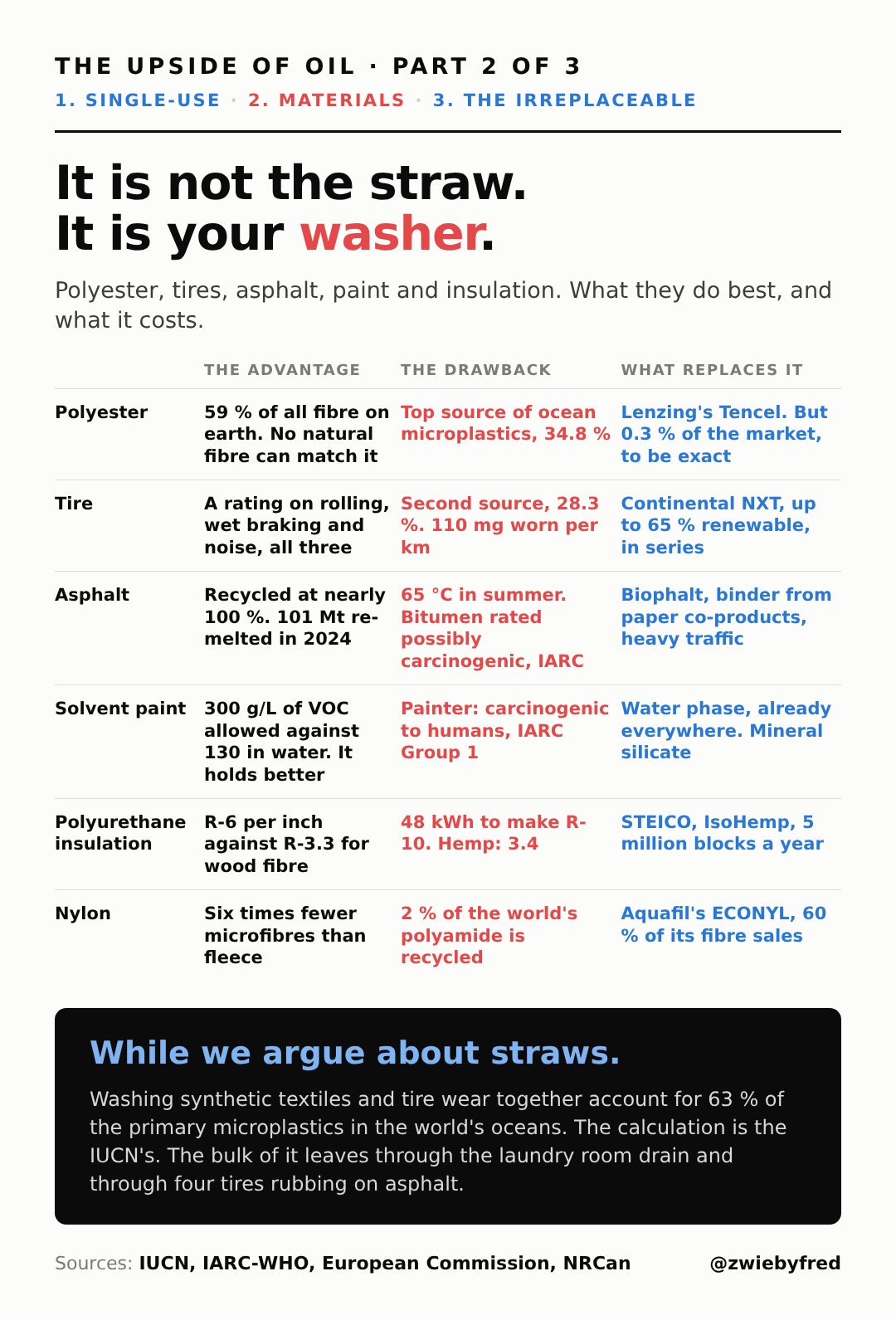
The two largest sources of microplastics in the world’s oceans are not bags, not straws, not bottles.
It is your washing machine, at 34.8 %. And your tires, at 28.3 %.
Between them, 63 % of the total. The calculation is the International Union for Conservation of Nature’s. Put plainly: while we argue about straws, the bulk of it leaves through the laundry room drain and through four tires rubbing on asphalt.
Same method as Saturday. The real advantage, the drawback welded to it, the alternative that already exists.
POLYESTER
The advantage is overwhelming and it has to be said honestly: 77.7 million tonnes out of 132 million tonnes of fibre produced worldwide in 2024. 59 % of everything that clothes this planet. Cotton tops out at 19 %, wool at 0.9 %, linen at 0.3 %. No natural fibre can match that volume. That is not marketing, it is agricultural arithmetic.
The drawback: every load releases microfibres, and in Europe alone that is 13,000 tonnes a year into surface waters, 25 grams per person.
And here I will argue against my own side, because that is what the science says. By mass, cotton and wool shed roughly as much fibre in the wash as polyester does. The difference is that natural fibres degrade and the others do not. Nylon sheds six times less. And the gap between the lowest-shedding and highest-shedding textiles exceeds 850 times. So it is not only the material, it is the finish of the fabric. A brushed fleece is its own case.
The alternative: Lenzing, in Austria, sells 904,000 tonnes of fibre a year, including Tencel made from wood pulp. Real and commercialized. But let us be exact: lyocell is 0.3 % of the world market. That is a beginning, not a replacement. For nylon, Aquafil in Italy already draws more than 60 % of its fibre revenue from regenerated nylon. And for fleece, Polartec has a treatment that cuts released fibre fragments by 85 %. It is still polyester, but it is 85 % less of it in the river.
THE TIRE
The advantage nobody ever tells: synthetic chemistry produced tires that earn the European A rating for rolling resistance, wet braking AND noise, all three at once. Less fuel without losing grip. That was impossible before.
The drawback: the European Commission’s Joint Research Centre aggregated about 300 measurements. A vehicle wears away an average of 110 milligrams of tire per kilometre. And the authors’ conclusion, which I quote: tire abrasion contributes one third to one half of the microplastics unintentionally released into the environment.
And yes, that applies to my car too. An electric vehicle is heavier, and it wears its tires. I am not going to pretend otherwise.
The alternative: Continental has been producing at volume in Portugal since July 2023 a tire containing up to 65 % renewable, recycled or certified materials. Resins from paper and wood industry residues. Silica made from rice husk ash. Nine to fifteen recycled PET bottles per tire. And every size keeps the A rating on all three criteria.
Be careful though with the widely shared Michelin tire at “45 % sustainable materials.” Michelin itself writes that it is a demonstrator. It is not a tire you can buy.
ASPHALT
Here I am going to defend petroleum, because numbers are numbers.
The advantage: 101.4 million tonnes of reclaimed asphalt pavement were reused during the 2024 season alone in North America, with a recycling rate approaching 100 %. Asphalt is not lost plastic. It is a material we re-melt. It is probably the most recycled material on the continent.
The drawback: the EPA measures summer surface temperatures up to about 65 °C. And the IARC classifies bitumens and their paving emissions as possibly carcinogenic, and oxidized bitumens in roofing as probably carcinogenic. The driver does not pay that bill. The person on the paver does.
The alternative: since 2020 Eiffage has been laying a mix whose binder comes from paper industry co-products, tough enough for heavy motorway traffic, and accepting up to 100 % reclaimed asphalt. Colas has the equivalent for light traffic, with a carbon footprint on average 70 % lower.
PAINT
The advantage: solvent gives flow, adhesion and wash resistance. Europe acknowledges it in its own regulation, allowing 300 grams of volatile organic compounds per litre in solvent phase for a wood and metal finish, against 130 in water phase. Solvent performs better. It is written into the law.
The drawback, and it is the heaviest in this text: the International Agency for Research on Cancer classifies occupational exposure as a painter in Group 1. Group 1 means carcinogenic to humans. Not “possible,” not “probable.” Established. Lung cancer risk up 35 % across 47 studies, and nearly doubled after ten years of exposure. Bladder, up 25 %, and up 81 % after ten years. After adjusting for tobacco.
If you know a painter, this section is for him.
The alternative: water phase, already everywhere, and mineral silicate paints, which have been commercially available for more than a century.
INSULATION
The advantage is real and measurable: Natural Resources Canada gives R-5.2 to 6.5 per inch for closed-cell polyurethane foam against R-3.3 for wood fibre. Nearly double the performance at equal thickness. When you only have five inches of wall, that counts.
The drawback: manufacturing energy. To get a panel delivering R-10 takes about 48 kWh with polyurethane against 3.4 kWh with hemp wool. Fourteen times more. That figure comes from Écohabitation, a Quebec organization, not a government laboratory, and I am telling you that rather than passing it off as official.
The alternative: STEICO in Germany, IsoHemp in Belgium with its hemp blocks and a capacity of 5 million blocks a year. And an honest caveat: the wood fibre panel also contains a polyolefin binder. It is not zero plastic. It is far less.
WHAT I CANNOT TELL YOU
I wanted to give you the best Quebec case in the file: a hemp fibre insulation maker in Val-des-Sources, the first in North America to obtain a conformity evaluation to the National Building Code. I found no document from 2025 or 2026 confirming it is still operating. So I am not naming it. I already came close to citing a bankrupt company as proof that something works, and I will not do it again.
Saturday, part 3 of 3, and it is the most important of the three: where petroleum is not replaceable. Fertilizer, medical equipment, aviation, hospital generators. If I did not write it, the first two would be worth nothing.
Part 2 of 3 in the series The upside of oil.
Sources: IUCN, European Commission (Joint Research Centre and Directive 2004/42/EC), IARC-WHO, vol. 100F and vol. 103, Textile Exchange, European Environment Agency, PLOS ONE, US EPA, Natural Resources Canada, IEA, NAPA, Écohabitation.