
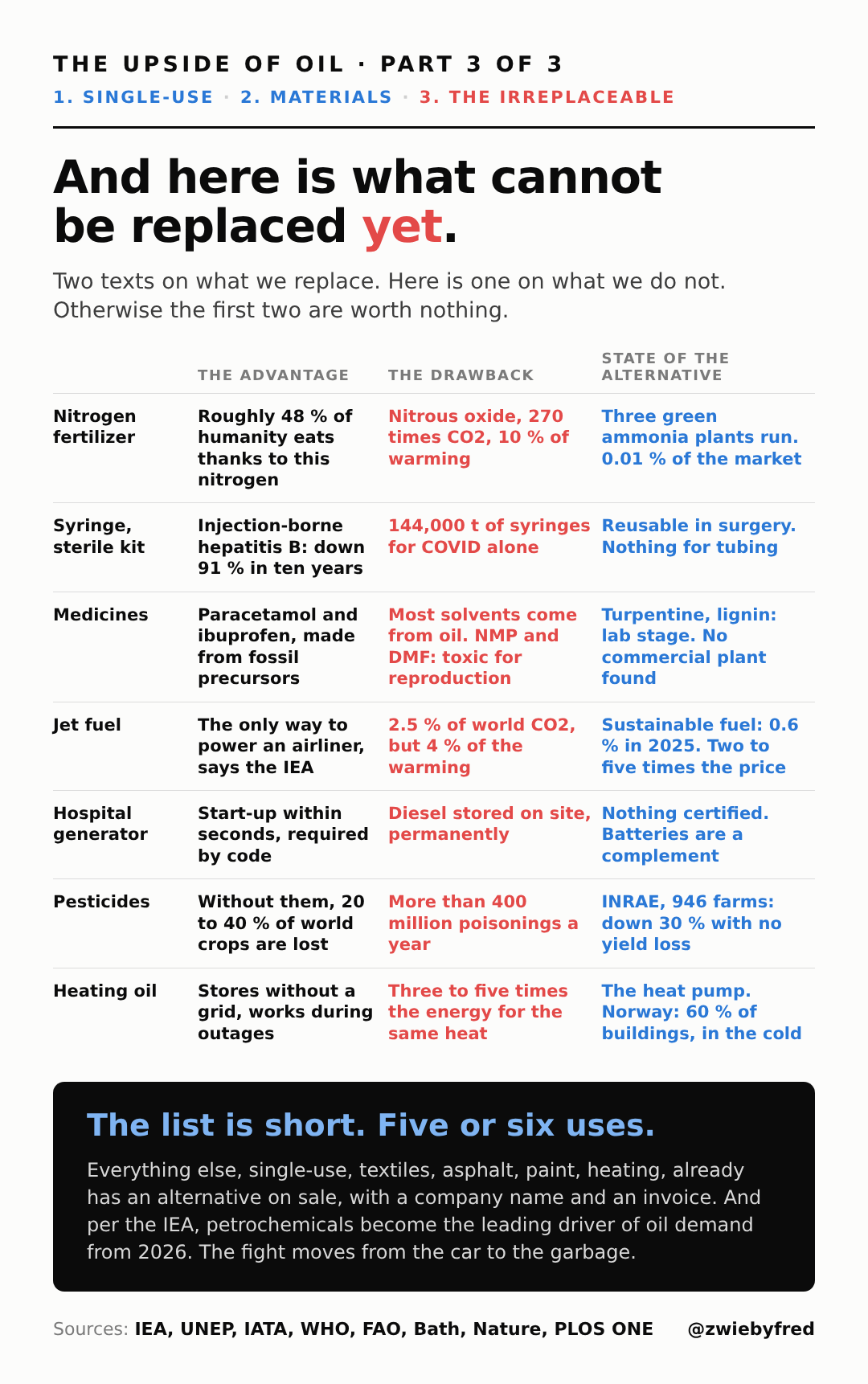
Two texts showing what can be replaced. Here is one on what cannot.
If I did not write it, the first two would be worth nothing.
There is an easy way to lose an argument: claim everything can be replaced tomorrow morning. The first person with a solid counter-example brings the rest down with it. So I will lay out the counter-examples myself.
NITROGEN
Start with the biggest, and with a wording point I do not want to get wrong: this is not oil, it is natural gas. More than 70 % of the world’s ammonia is made by reforming natural gas. If you hear me say “oil feeds half of humanity,” correct me. It is fossil hydrocarbons.
Now the advantage. In 2008 five researchers published an estimate in Nature Geoscience that has never been seriously challenged since: roughly 48 % of humanity lives thanks to nitrogen made by the Haber-Bosch process. Half the world. Across a century, roughly four billion births.
You want an invention that changed the fate of the species, there is one.
The drawback matches it. Ammonia production emits 450 megatonnes of CO2 a year directly, and the IEA writes that per tonne it is nearly twice as emissions intensive as steel and four times cement. Then, in the field, some of that nitrogen turns into nitrous oxide, about 270 times more powerful than CO2 and responsible for roughly 10 % of warming since the industrial revolution. UNEP, November 2024: without urgent action on nitrous oxide, there is no viable pathway to limiting warming to 1.5 degrees.
And the waste is enormous: per Nature Food, only 46 % of the nitrogen applied ends up in the crop. More than 500 dead zones in the oceans, a number that has doubled every decade since 1960.
The alternative, and here we have to be straight. Green ammonia exists and three plants genuinely run: Puertollano in Spain, Herøya in Norway, Ramme in Denmark since December 2025. These are not mock-ups. But the IEA writes that of nearly 100 million tonnes of hydrogen produced in 2024, less than 1 % came from low-emissions processes. Renewable ammonia is about 0.01 % of world production.
What already works is not glamorous but it is measured: Agriculture and Agri-Food Canada tracked a lentil-wheat rotation over 25 years in the West. Nitrogen requirements down 29 %, grain production up more than 35 %, durum’s carbon footprint down 22 %. The legume does for free what the plant does with natural gas.
THE SYRINGE
The advantage has been quantified, and the number is stunning. A team at the Université de Sherbrooke published in PLOS ONE the tally of infections transmitted by unsafe injections between 2000 and 2010.
Hepatitis B: from 19.7 million cases to 1.7 million. Down 91 %. Hepatitis C: down 83 %. HIV: down 87 %.
In ten years, because we moved from reused equipment to single-use. In 2000, 40 % of the 16 billion annual injections were still given with reused equipment. And vaccination, which depends entirely on vials, syringes and a plastic cold chain, has saved at least 154 million lives in fifty years according to the WHO.
The drawback: during COVID the WHO counted 87,000 tonnes of protective equipment and 144,000 tonnes of syringes, needles and safety boxes. A partial tally, it notes.
The alternative exists, but only for part of it. A study published in Eye, at Nature, measured cataract surgery: 322 kg CO2e per case with single-use instruments against 12 kg with the reusable equivalent. Twenty-seven times less, and break-even comes at 19 reuses.
For tubing, IV bags and catheters, though, there is nothing. Bio-based plastics are about 0.5 % of world plastic production, and that share is not moving.
MEDICINES
The advantage first. Paracetamol, the active ingredient in Tylenol, is on the WHO list of essential medicines and is one of the drugs made in the largest quantities in the world. What fewer people know: making it starts from a benzene derivative. Researchers at Columbia and Georgia Tech describe the classic route as nitration of benzene derived from petrochemicals. A University of Wisconsin patent says coal tar instead. Either way, it is fossil carbon. For its part, the University of Bath writes that many common pharmaceuticals, including paracetamol and ibuprofen, are made with precursors derived from crude oil.
And the pharmaceutical petroleum jelly, the base of many ointments? Its monograph defines it as a purified mixture of semi-solid hydrocarbons obtained from petroleum.
The drawback: according to Josh Tibbetts, a chemist at Bath, making pharmaceuticals with oil adds to CO2 emissions, and the price swings widely because we depend on the political stability of producing countries.
The alternative exists, but it is at lab stage. The Bath team made paracetamol and ibuprofen from β-pinene, a turpentine by-product of the paper industry (ChemSusChem, 2023). At Wisconsin-Madison, paracetamol was obtained from poplar lignin. The Bath researchers admit their process may cost more than the oil-based one. A life cycle assessment of the β-pinene process estimates that a European plant supplied with turpentine from pulp mills in its region would produce about one tonne of paracetamol a day, and writes that the process is currently not of commercial interest. I found no commercial plant making paracetamol from biomass.
This applies to synthetic chemistry drugs. Fermentation antibiotics and insulin, for example, follow a different route.
You will see percentages of medicines “made from oil” going around. I found none with a real source, so I am not writing one.
PHARMACEUTICAL SOLVENTS
A reader asked me under part 1 of 3: what about the oil-derived solvents used to make drugs for diabetes, cancer and other diseases?
Here is what I found. Solvents take up an enormous share. In measurements from seven pharmaceutical companies brought together by the ACS Green Chemistry Institute Pharmaceutical Roundtable (around 2007), solvents made up 49 % of the mass of materials in an active-ingredient manufacturing process, and about 80 % with water. The figure is old, and that has to be said.
Most solvents come from oil, as Angellotti and colleagues write in a review published in December 2025. And several are a problem: NMP and DMF are classified H360 (toxic for reproduction) under the European REACH regulation.
The alternative exists in part. 2-MeTHF, a plant-based solvent, is classed by the pharmaceutical industry as low toxicity (class 3, the same as ethanol), with a market of 450 million dollars in 2024. But this is not a fairy tale: the world’s first manufacturer of dihydrolevoglucosenone (Cyrene), another plant-based solvent, went bankrupt in late 2024.
I found no source linking specific solvents to a particular drug for diabetes or cancer. So I name no drug.
THE AIRPLANE
This is not me talking, it is the International Energy Agency: liquid hydrocarbon fuels like jet fuel remain the only means of powering commercial air travel.
The drawback: about 2.5 % of global CO2 emissions, but around 4 % of the temperature rise, because two thirds of aviation’s effect comes from something other than CO2, mainly contrails.
The alternative, and here is the number nobody puts on a poster. IATA, December 2025: sustainable aviation fuel reached 1.9 million tonnes in 2025. That is 0.6 % of world jet fuel consumption. Forecast for 2026: 0.8 %. And that forecast is a downward revision. The price: double fossil kerosene, and up to five times more in mandated markets. The IEA projects 2 % by 2030.
And the electric plane? Volocopter laid off its entire workforce in insolvency. Lilium went bankrupt a second time in February 2025. I will not cite them as proof that it is coming.
THE HOSPITAL GENERATOR
The most locked-in case in the file, and for a reason that has nothing to do with economics. Safety codes require hospitals to have a standalone backup supply that starts within seconds, with fuel stored on site. That is not a manager’s choice, it is a standard. Battery microgrids are being deployed as a resilience complement, not a replacement.
You will see “96 hours of reserve” going around. The standards are paywalled, I could not read the text, so I am not writing it.
PESTICIDES
The advantage, per the FAO: without pest control, pests and disease cost 20 to 40 % of world crop yields. The drawback: 402 to 433 million unintentional acute poisonings a year, and about 11,000 deaths. A warning for anyone chasing the source: the 385 million figure everyone cites comes from a 2020 paper retracted in October 2024. The same authors republished a corrected version in September 2026.
The alternative is demonstrated at scale. INRAE analysed 946 French farms: reduction of 30 % on average is possible, 42 % for farms that change system, while maintaining or improving productivity in 94 % of cases. The caveat is in the study itself: no economic gain in 89 % of cases. This will not happen on its own through the market.
AND FINALLY, THE EASY ONE
Home heating oil. That one does get replaced.
The IEA: a heat pump is three to five times more efficient than a gas boiler, and cuts emissions by up to 80 % with clean electricity like ours. And for those who keep repeating that it does not work in the cold: Norway has 60 % of its buildings equipped, Sweden and Finland more than 40 %.
Worth noting because it touches real people: the federal oil-to-heat-pump affordability program has been closed to new applications since 31 July 2026.
WHAT I TAKE FROM THESE THREE TEXTS
Oil and gas did things nothing else did. Fed half the world. Cut injection-transmitted hepatitis by 90 %. There is nothing to gain by denying it, and a lot to lose by trying.
But the list of what is genuinely irreplaceable is short. Five or six uses. The rest, single-use, textiles, asphalt, paint, heating, already has an alternative on sale, with a company name and an invoice.
And the real issue is no longer the tank. Per the IEA, petrochemicals become the dominant source of global oil demand growth from 2026 onwards. More than one barrel in six by 2030.
Which means the fight moves from the car to the garbage. And that it is going to be longer.
Part 3 of 3 in the series The upside of oil.
Sources: Nature Geoscience, Nature Food, PLOS ONE, Eye (Nature), Nature Plants, Frontiers in Public Health, IEA, UNEP, IRENA, IATA, WHO, FAO, UNDP, NOAA, Agriculture and Agri-Food Canada, Natural Resources Canada, US EPA, European Bioplastics, University of Bath (ChemSusChem), AIChE, WARF (University of Wisconsin), NIH (NCATS), ACS GCI Pharmaceutical Roundtable, RSC Sustainability, ScienceDirect.