
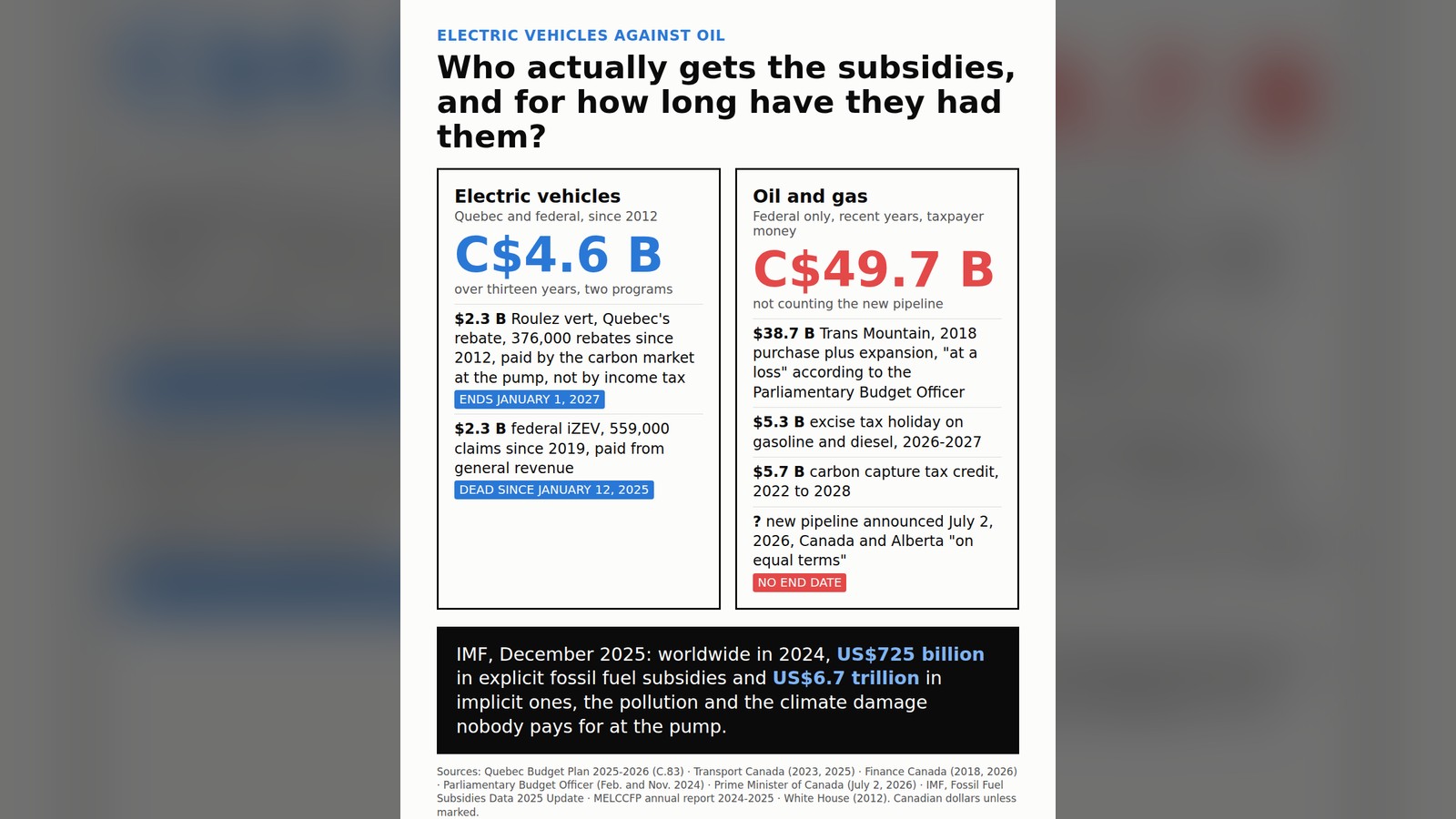
The rebate that paid for my car ends on January 1, 2027. The federal one died in January 2025. On the day the Quebec program closes, the federal gas tax will still be at zero and a new pipeline, with public money in it, will be on the table.
“We all pay for your electric car subsidy.” For the federal program that is true: iZEV, C$2.3 billion since 2019, came out of general revenue. For Quebec it is not. Roulez vert, the provincial rebate, C$2.3 billion since 2012, is paid by the electrification fund, which receives all of the carbon market revenue. The carbon market is the roughly 10 cents a litre you already pay at the pump. Every fill-up pays for the rebate on my car, and since I charge on hydro I put almost nothing into it. C$4.6 billion over thirteen years, and both programs are now closing.
Mind you, we do pay tax to drive. Sales tax applies to the electricity, which runs C$50 to C$75 a year depending on the car, plus the C$125 road charge starting in 2027. Less than a gasoline car, I will not pretend otherwise. But it is not zero. And you will tell me there are programs that reimburse part of home charging. There are, and they are new. How long they will last, nobody can tell you: they come out of that same fund, and that fund runs down.
Now the oil side, federal only, just these last few years. Trans Mountain: C$4.5 billion to buy it in 2018 plus C$34.2 billion to expand it, at a loss according to the Parliamentary Budget Officer. The excise tax holiday on gasoline and diesel through January 31, 2027: C$5.3 billion. The carbon capture tax credit: C$5.7 billion. And a new pipeline announced on July 2, Canada and Alberta as equal partners, with no figure attached yet. Around C$50 billion. Eleven times what the electric cars got.
Worldwide, the IMF counts US$725 billion in explicit fossil fuel subsidies in 2024 and US$6.7 trillion in implicit ones, the pollution and the climate nobody pays for at the pump. Back in 2012 the White House was already describing “nearly 100 years” of subsidies to the oil industry.
Where I land: I am for EV incentives until price parity, not a day longer. But if you want to be angry about subsidies, be angry about the right ones. The ones that are a century old and have no end date.
Sources: Quebec Budget Plan 2025-2026 · Transport Canada · Finance Canada · Parliamentary Budget Officer · Prime Minister of Canada, July 2, 2026 · IMF, Fossil Fuel Subsidies Data 2025 Update · MELCCFP · White House, 2012
What does the subsidy ledger look like where you live?