
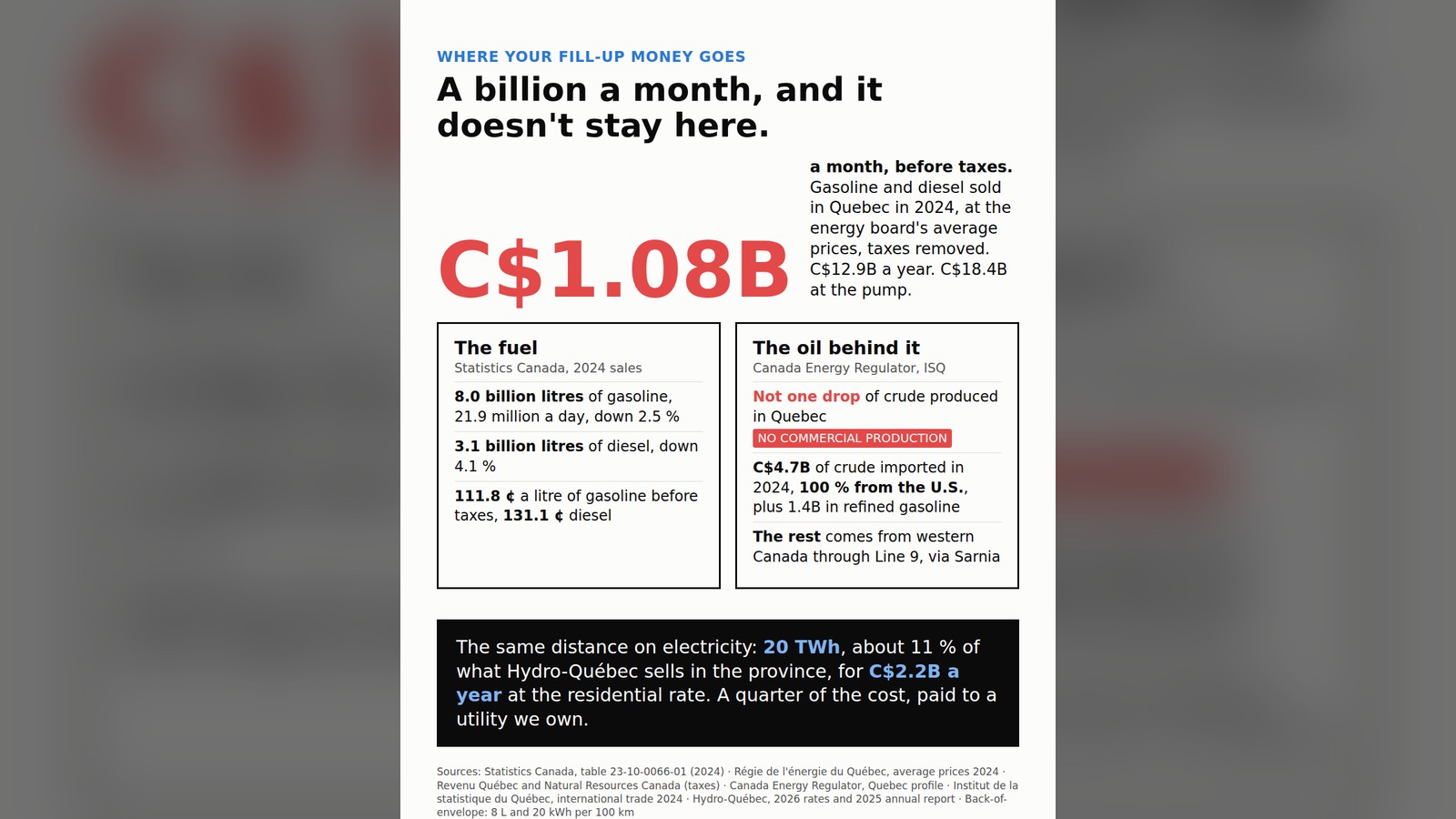
A billion dollars a month. That is what Quebec spends on gasoline and diesel before taxes, for oil the province does not produce a single drop of.
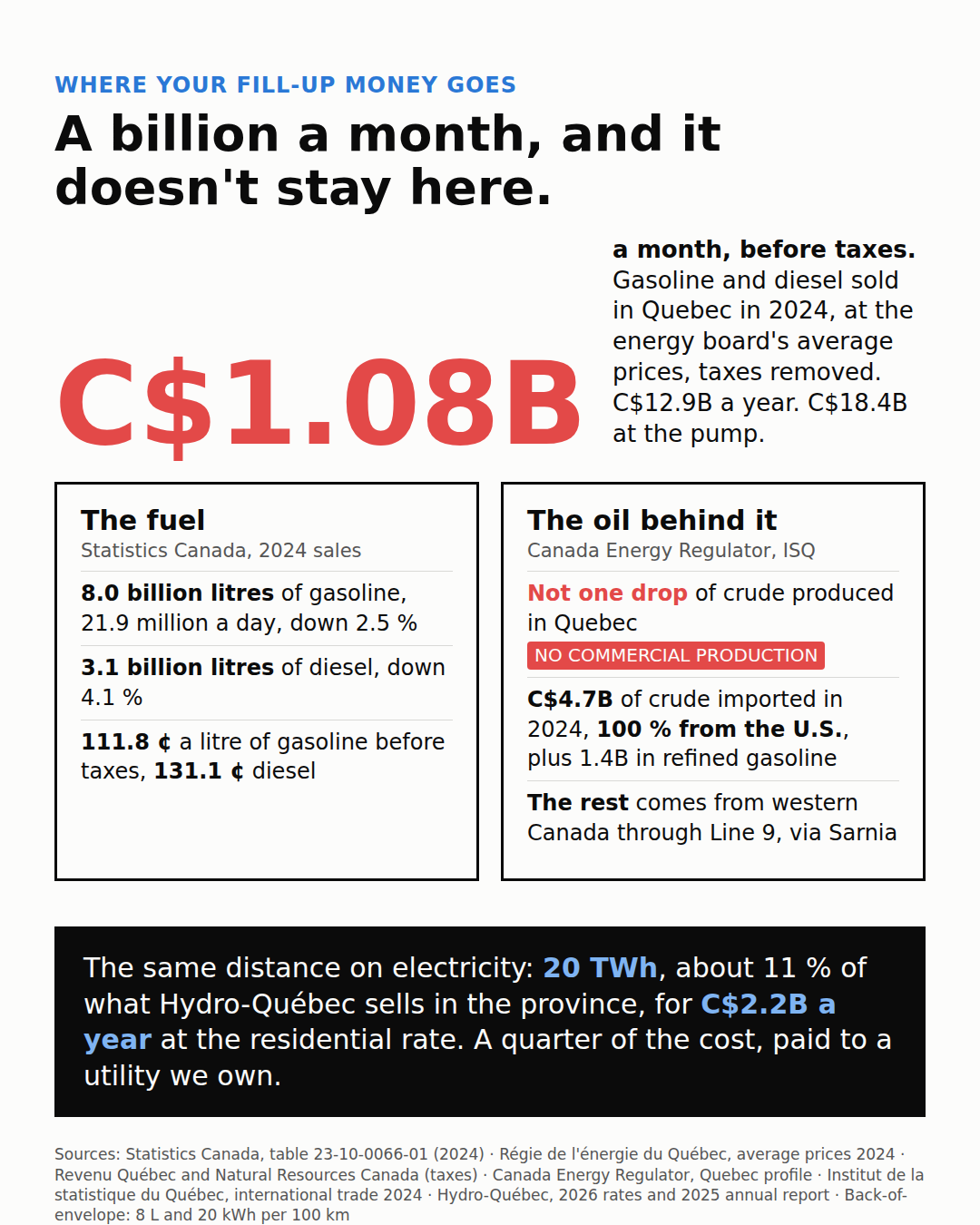
Statistics Canada published the 2024 road fuel sales last September, so I redid the whole calculation. Quebec burned 8.0 billion litres of gasoline and 3.1 billion litres of diesel that year, down 2.5 and 4.1 percent from 2023. At the average pump prices published by Quebec’s energy board, minus GST, provincial sales tax, federal excise and the provincial fuel tax, that comes to C$12.9 billion a year, or 1.08 billion a month. With the taxes back in, 18.4 billion goes through the pumps.
The part that surprises people from outside Quebec is where it goes. The province has no commercial crude oil production at all, according to the Canada Energy Regulator. Our two refineries, in Montreal East and in Lévis, get their crude from the United States, C$4.7 billion worth in 2024 and 100 percent American according to the provincial statistics institute, plus another 1.4 billion in already refined gasoline, and from western Canada through Enbridge’s Line 9. I will be fair about this: the refining, the tanker trucks, the stations and the people who work in them stay here. The crude does not, and the crude is the big piece of the price.
Now the other side of the ledger. Those 8 billion litres, at 8 L/100 km, are roughly 100 billion kilometres a year. The same distance on electricity at 20 kWh/100 km, which is my Model X’s rating and thirstier than the fleet average, needs 20 terawatt-hours. Hydro-Québec, the province-owned utility, sold 185 TWh here in 2025, so we would need about 11 percent more. Somebody has to build that, it is not free, but it is not the end of the world either. And it would cost around C$2.2 billion a year at the residential rate, against 8.9 billion for the gasoline it replaces.
Quebec runs on hydro, so these numbers are close to the best case in North America. That is exactly why they are worth looking at. If electrification does not pay here, it does not pay anywhere.
What does your province or your state import to keep its cars running, and what does that cost you every month?
Sources: Statistics Canada, table 23-10-0066-01 · Régie de l’énergie du Québec · Canada Energy Regulator · Institut de la statistique du Québec · Hydro-Québec 2025 annual report