
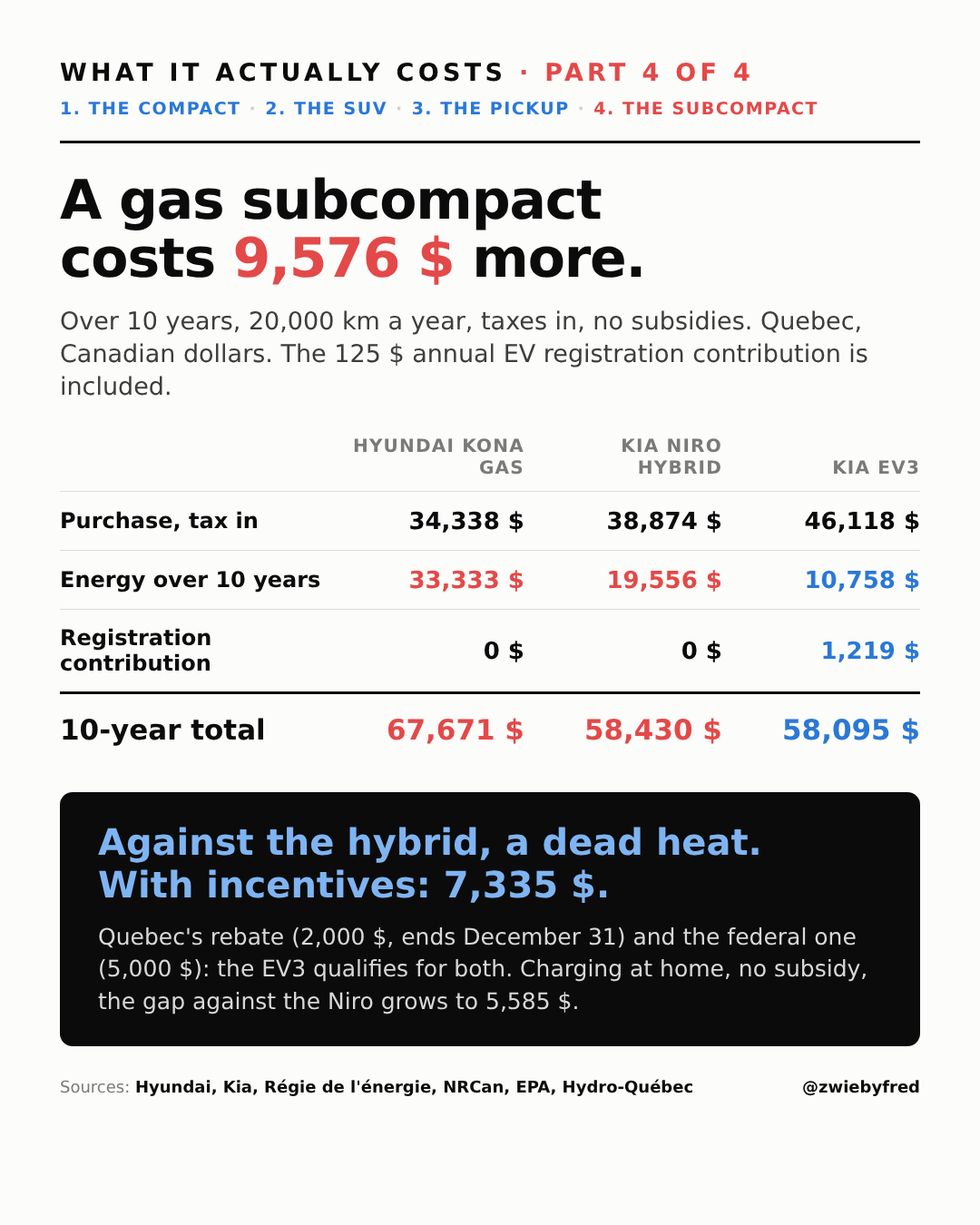
Against the gas Kona, the Kia EV3 saves 9,576 $ over ten years. Against the Niro hybrid, 335 $. Not one cent of subsidy.
Part 4 of 4 of the series: what it actually costs. The subcompact: the first new car, the second car in the driveway, the tight budget. Quebec numbers, Canadian dollars.
THE THREE CARS
Hyundai Kona Essential 2026, front-wheel drive, 2.0 L. 29,866 $ before tax, all in, on Hyundai Canada’s configurator for Quebec.
Kia Niro Hybrid LX 2026. 33,811 $ before tax: 30,845 $, plus 2,035 $ delivery, 699 $ dealer fees and 232 $ of other fees, on Kia Canada’s configurator.
Kia EV3 Light 2027, front-wheel drive. 39,412 $ on Kia’s configurator. It does not show the 699 $ dealer fee for the EV3, so I add it anyway, to give it no favours: 40,111 $.
I will say it before anyone else does: the EV3 costs 10,245 $ more than the Kona to buy.
THE ASSUMPTIONS, SAME AS THE OTHER THREE PARTS
20,000 km a year, for 10 years. Taxes included. Gas at 2.00 $ a litre, the price Quebec’s energy board logged in Montreal.
The Kona is rated 7.5 L/100 km. For the Niro, I take the rating of its most efficient version, 4.4 L/100 km, on purpose. I add the same 11 % real-world gap to both: 8.3 and 4.9.
Natural Resources Canada rates the EV3 Light at 2.0 Le/100 km, about 17.8 kWh/100 km. I use 17.9 and raise it 20 %, to 21.5. Electricity at 0.25 $ per kWh, deliberately high. That is like doing about a third of your charging at 0.50 $ fast chargers, and the rest at home. And the 125 $ annual EV registration contribution, 1,219 $ over nine years, is in the table.
THE TABLE
Hyundai Kona gas Purchase, tax in: 34,338 $ Gas over 10 years: 33,333 $ Total: 67,671 $
Kia Niro hybrid Purchase, tax in: 38,874 $ Gas over 10 years: 19,556 $ Total: 58,430 $
Kia EV3 Purchase, tax in: 46,118 $ Electricity over 10 years: 10,758 $ Registration contribution: 1,219 $ Total: 58,095 $
9,576 $ less than the Kona. Against the Niro hybrid, 335 $: a dead heat, like the SUV part.
Using the official ratings with no real-world gap on either side: 8,036 $ against the Kona and 172 $ against the Niro. And with the regular Niro, rated 4.8 instead of 4.4, the gap grows to 2,112 $.
WHAT TIPS THE BALANCE
The incentives, and one of them has 54 days left. Quebec’s rebate still pays 2,000 $ until 31 December 2026, zero in 2027, and registration date is what counts. The federal program pays 5,000 $ at the point of sale in 2026, 4,000 $ in 2027. The EV3 is built in South Korea, covered by the Canada-Korea free trade agreement, and costs under 50,000 $: it qualifies for both, and Kia applies them on its own configurator. With both, the gap climbs to 16,576 $ against the Kona and 7,335 $ against the Niro.
Charging at home. At about 12.8 cents per kWh, the EV3 comes to 52,845 $ over ten years: 14,826 $ less than the Kona, 5,585 $ less than the Niro, still with no subsidy.
Mileage. At 30,000 km a year, the gap against the Niro grows to 4,733 $. At 40,000, to 9,132 $.
WHERE THE MONEY GOES
The Kona and the Niro are built in South Korea, like the EV3. None of the three is made here. But over ten years, the Kona burns 33,333 $ of gasoline and the Niro 19,556 $. That money leaves Quebec. The EV3’s 10,758 $ of electricity stays here.
WHAT IS NOT IN THE TABLE
No oil changes, no spark plugs, no belts, no exhaust. The hybrid still needs them. I put no number on it, for lack of a solid ten-year Quebec source. But it all leans the same way.
THE WHOLE SERIES
Against gas, over ten years, no subsidies: The compact: 9,945 $ less The compact SUV: 16,054 $ less The pickup: 30,061 $ less The subcompact: 9,576 $ less
Four segments, the same result four times. The hybrid holds its own: a dead heat in the SUV and the subcompact, behind in the compact. But the gas-only car costs more everywhere, and no sticker says so.
What about you: Niro hybrid or EV3?
Part 4 of 4 in the series What it actually costs.
Sources: Hyundai Canada, Kia Canada, Régie de l’énergie du Québec, Hydro-Québec, Natural Resources Canada, US EPA, Quebec Ministry of Finance (Budget 2025-2026), Québec.ca, Transport Canada (EVAP).